
Thousands of transportation occurrences are reported to the TSB each year. These range from aircraft component failures and ship fires to pipeline ruptures and train derailments. When notified of an occurrence, the TSB assesses the circumstances to determine whether an investigation is warranted. When necessary, a team may be deployed to the site.
The TSB launches an investigation when it is likely to advance transportation safety or reduce risks to people, property, or the environment (see the Occurrence Classification Policy). While most investigations take place in Canada, the TSB also supports foreign investigations when appropriate.
The TSB also monitors occurrence statistics to identify trends and emerging safety issues. It reviews developments in transportation safety and identifies safety risks that it believes government and the transportation industry should address to reduce injury and loss of life.
Video 1. Inside the TSB: How we investigate transportation occurrences
Transcript of the video
Every year, thousands of occurrences are reported to the TSB.
Each one is carefully assessed, and we investigate those that will yield critical safety information, that will prevent these occurrences from happening again.
From the accident scene to the report release, there are a number of steps in between.
It all starts when we deploy to an accident site and begin to document what we find: the environment, the wreckage… anything relevant to the investigation.
We conduct interviews with witnesses, survivors, and company representatives, as well as gathering maintenance and training records, and weather information.
The next steps are all about the science. Our experts disassemble engines, brakes, rotors, and instrumentation, and download any data from black boxes or recorders. If it moves, whirs or hums, we'll look inside to see what role it may have played.
And then there's the human element. What did the crew see? What about the regulations, the operational environment, or organizational factors including safety management?
No one ever sets out to have an accident, so how exactly did events unfold? In other words, if we can understand the factors underlying the decisions that were made, we may be able to gain valuable insight.
The last step is to write a report that states the facts, explains our analysis, and communicates our findings to Canadians.
If risks continue to exist, we point them out, and when strong safety action is required, we make compelling arguments for change—until all safety deficiencies are addressed.
That said, we don't always wait until the conclusion of an investigation to communicate. If we identify pressing safety issues, we immediately inform the regulator and industry.
At the TSB we share one common mission: to make Canada safer. And so, as Canada’s transportation industry and the landscape continue to evolve, we'll keep pushing for the changes that need to be made.
That's our commitment—to Canada and to the world.
Our resources
The TSB is led by a Board of up to five members, including the Chair. Approximately 220 employees support the organization across Canada. Our head office is in Gatineau, Quebec, and our engineering laboratory is in Ottawa, Ontario (see the organizational structure). Investigators are located in eight regional offices, enabling rapid response anywhere in the country.
Our investigation methodology
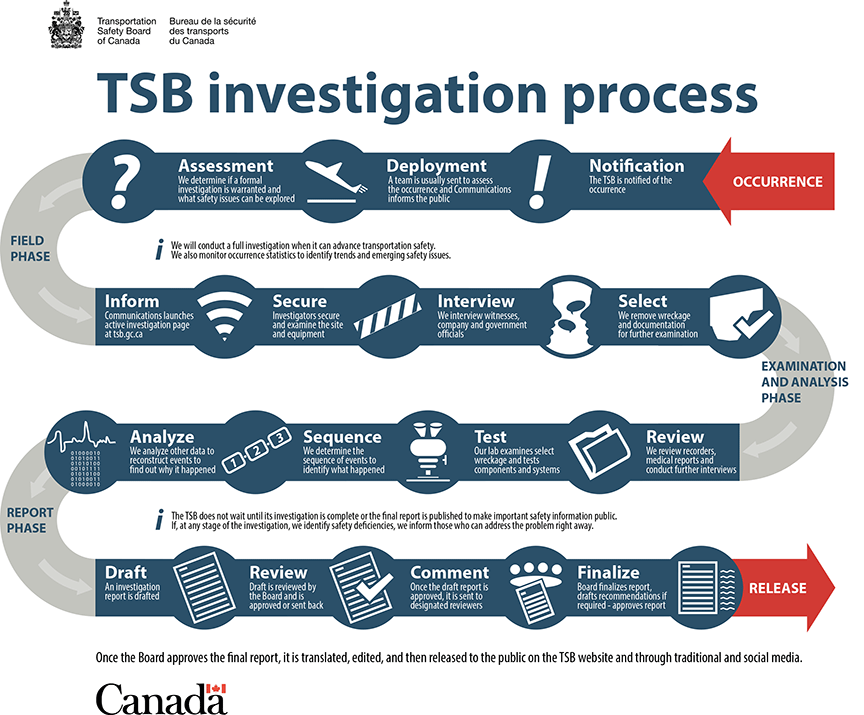
There are three phases to a TSB investigation: the field phase, the examination and analysis phase, and the report phase.
Field phase
Once an investigation is initiated, an Investigator‑in‑Charge is assigned and an investigation team is formed. Depending on the occurrence, the team may include experts in operations, engineering, equipment, maintenance, and human performance.
During the field phase, the investigation team typically:
- informs the public of TSB deployment;
- secures and documents the occurrence site;
- examines and photographs equipment or wreckage;
- conducts interviews with any person who may have information relevant to the investigation (find out more about being interviewed by the TSB);
- collects evidence for further examination; and
- reviews documentation.
Examination and analysis phase
Most investigative work occurs after leaving the site. During this phase, the TSB may:
- review company, equipment, and government records;
- conduct laboratory examinations and testing;
- analyze data, such as recorder information;
- create simulations or reconstructions;
- review autopsy or toxicology reports;
- conduct follow‑up interviews;
- establish the sequence of events; and
- identify safety deficiencies.
If urgent safety deficiencies are discovered at any point, the TSB promptly notifies those who can take corrective action even before an investigation is complete.
Report phase
Following the examination and analysis phase, a draft investigation report is prepared. The Board reviews the draft and may approve it or request amendments. Once approved, the draft is shared confidentially with designated reviewers—individuals or organizations who have a direct interest in the Board’s findings.
After considering and addressing reviewer comments, the Board approves the final report. It is then released publicly on the TSB website. Reports are published as quickly as possible while ensuring they meet the TSB’s commitment to thorough, evidence‑based analysis.
Who is involved in a TSB investigation?
The TSB works closely with many stakeholders during an investigation, including all levels of government, transportation companies, manufacturers, regulators, survivors and next of kin, first responders (see how first responders support TSB investigations), coroners, medical examiners, and search‑and‑rescue organizations. Effective collaboration is essential to delivering on our mandate.
Families, Loved Ones, and Survivors
In fatal occurrences, police, coroners/medical examiners, or transportation companies notify next of kin. The TSB has a Liaison Officer who can serve as a point of contact for families, loved ones and survivors (see how we communicate with families, loved ones and survivors).
Observers
The TSB may grant observer status to individuals or organizations with a direct interest and the potential to contribute to transportation safety. Observers—typically regulators, manufacturers, or transportation companies—participate under the supervision of TSB investigators and in accordance with established rules.
Investigation information
Information gathered during a TSB investigation—including on‑board recordings, witness statements, and representations to the Board is privileged under the Canadian Transportation Accident Investigation and Safety Board Act.