
Collision with terrain
Chinook Helicopters (1982) Ltd.
Cessna 172S, C-GHCC
Abbotsford Airport (CYXX), British Columbia, 43 NM E
The Transportation Safety Board of Canada (TSB) investigated this occurrence for the purpose of advancing transportation safety. It is not the function of the Board to assign fault or determine civil or criminal liability. This report is not created for use in the context of legal, disciplinary or other proceedings. See Ownership and use of content. Masculine pronouns and position titles may be used to signify all genders to comply with the Canadian Transportation Accident Investigation and Safety Board Act (S.C. 1989, c. 3).
History of the flight
On 05 April 2025, the Chinook Helicopters (1982) Ltd. Cessna 172S airplane (registration C-GHCC, serial number 172S10459) was conducting a visual flight rules (VFR) training flight out of Abbotsford Airport (CYXX), British Columbia (BC)All locations are in the province of British Columbia, unless otherwise indicated., with 1 instructor and 1 student on board. Records and reports indicate the planned purpose of the flight was instrument flight training in the Sumas practice area.The Sumas practice area is not defined on aeronautical charts published by NAV CANADA. The investigation determined that this term was used by instructors at Chinook Helicopters (1982) Ltd. to refer to an area approximately 20 nautical miles (NM) east of CYXX.
The aircraft departed from Runway 01 at CYXX at approximately 1228All times are Pacific Daylight Time (Coordinated Universal Time minus 7 hours). and proceeded east. Approximately 34 nautical miles (NM) east of CYXX, the aircraft turned southeast and began climbing at 175 fpm while flying over Chilliwack Lake (Figure 1).
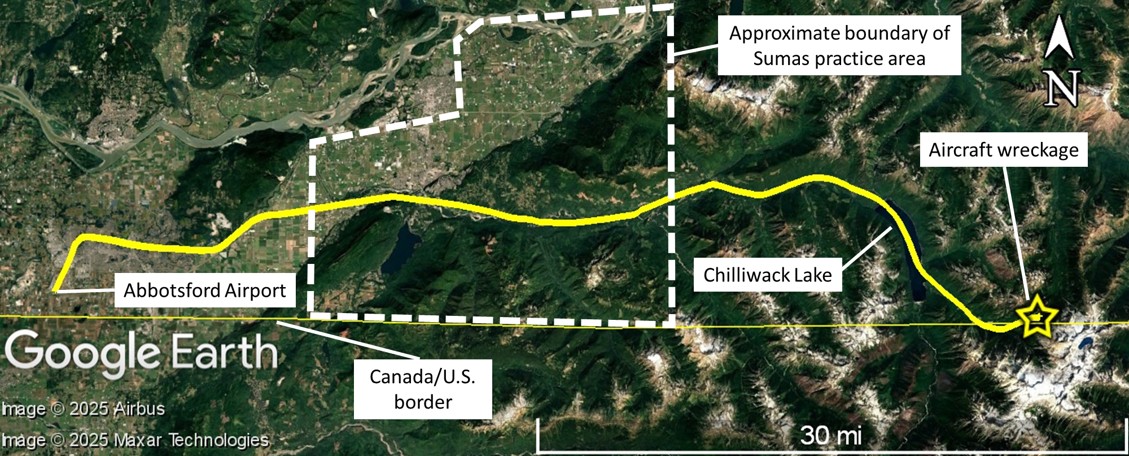
Reaching the southeast end of the lake, and still climbing, the aircraft crossed briefly into the United States, then back into Canada while following a valley. At 1259, when the aircraft crossed back into Canada, it was at an altitude of 3915 feet above sea level (ASL), climbing at approximately 500 fpm.
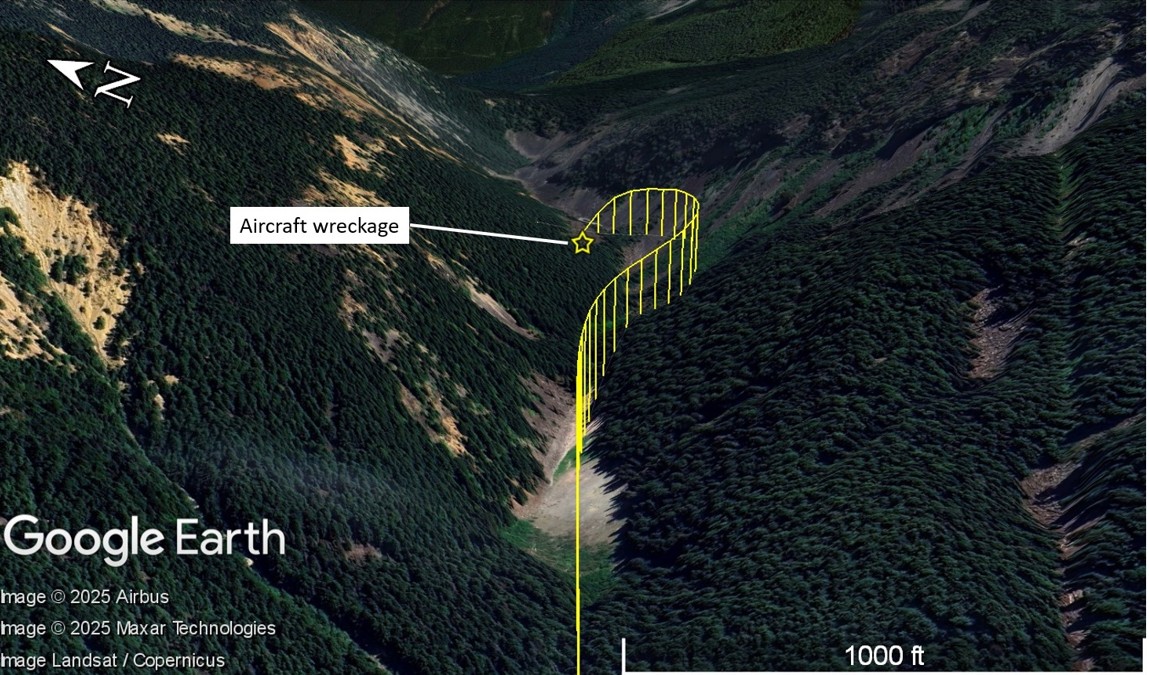
Approximately 30 seconds later, while climbing through 4250 feet ASL, the aircraft turned to manoeuvre toward the south side of the valley it was following. The aircraft’s ground speed decreased from 78 knots to 72 knots as it continued to climb. Ten seconds later, the aircraft began a turn to the left, while climbing through 4342 feet ASL.
Over a span of 8 seconds the aircraft descended approximately 350 feet, while slowing from 72 knots to 45 knots ground speed in a left turn. The aircraft then began to accelerate while continuing to descend. At 1300, the aircraft impacted terrain at approximately 4000 feet ASL while heading northwest (Figure 2). Both occupants of the aircraft were fatally injured.
The aircraft’s emergency locator transmitter (ELT) activated, and a 406 MHz signal was received by the Joint Rescue Coordination Centre in Victoria, BC, at approximately 1300.
Instructor information
The instructor, who was seated in the aircraft’s right seat, held a commercial pilot licence – aeroplane, with multi-engine class and instrument ratings. At the time of the occurrence, the instructor had accumulated approximately 1602 hours total flying time,All instructor flight hours are approximate and exclude the occurrence flight. with approximately 1500 hours in the occurrence aircraft type. His Category 1 medical certificate was valid.
The instructor completed 3 mountain familiarization training flights on 06 November 2020 at a flight training unit based at Vancouver/Boundary Bay Airport (CZBB), BC. These 3 flights reportedly did not constitute what the flight training unit considered a complete mountain checkoutTransport Canada neither regulates nor requires flight training specific to flight in mountainous terrain. and were not intended to fully prepare the instructor for intentional flight into mountainous areas.
One of the flights included training intended to cover course reversals in mountain valleys, also known as canyon turns. During that flight, 1 turn was demonstrated to the occurrence instructor and 1 turn was then performed by the occurrence instructor. However, both turns were performed between 7000 and 8000 feet ASL above non-mountainous terrain,Turns were reportedly performed above a golf course that had an elevation of between 10 and 100 feet ASL in the Pitt Lake practice area, BC. and both turns were 360° rather than 180° course reversals. The investigation did not identify any evidence that the occurrence instructor had received training for a course reversal while flying in actual mountainous terrain.
There was no indication that the instructor’s performance was negatively affected by medical, pathological, or physiological factors, including fatigue.
Student information
The student, who was seated in the left seat, held a commercial pilot licence – helicopter, with a night rating. At the time of the occurrence, the student had accumulated 140 hours total flying time, with 130.9 hours in helicopters and 9.1 hours in fixed-wing aircraft. The student’s Category 1 medical certificate was valid.
The student was completing a Group 4 (helicopter) instrument rating. Of the 40 hours of instrument experience required for that rating, 5 hours are required to be flown in a helicopter,Transport Canada, SOR 96/433, Canadian Aviation Regulations, clause 421.46(2)(b)(ii)(B). with the remaining hours of instrument training permitted in fixed-wing aircraft. The occurrence flight was the last planned fixed-wing flight for the student’s instrument rating. The student’s total fixed-wing flying experience consisted of instrument flying and navigation exercises.
There was no indication that the student’s performance was negatively affected by medical, pathological, or physiological factors, including fatigue.
Weather information
Weather was not considered to be a factor in this occurrence.
Aircraft information
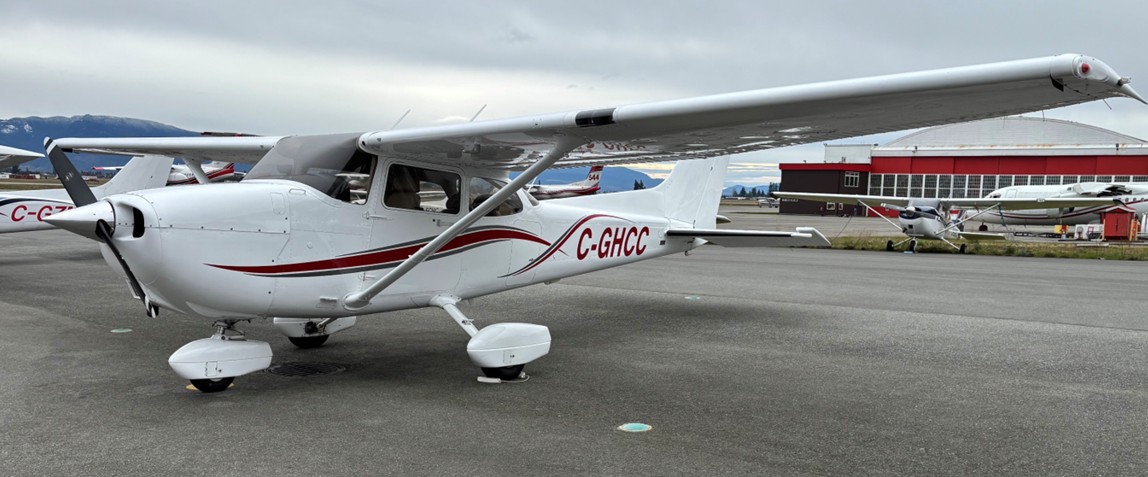
The occurrence aircraft was a Cessna 172S manufactured in 2007 (Figure 3). It was equipped with a Lycoming IO-360-L2A fuel-injected engine and a metal, fixed-pitch propeller. At the time of the occurrence, the aircraft had flown approximately 7802 hours. The aircraft’s last annual inspection occurred on 31 March 2025.
A disassembly and examination of the aircraft engine were performed at an engine repair facility in Kamloops, BC, with a TSB investigator in attendance. The examination did not reveal any issues that would have been a factor in this occurrence.
Flight dispatch and flight following
The occurrence flight was operating approximately 43 NM away from the departure aerodrome. To be compliant with the Canadian Aviation Regulations (CARs), the pilot-in-command was required to file either a flight plan or flight itinerary.Transport Canada, SOR 96/433, Canadian Aviation Regulations, subsection 602.73(2) states that “no pilot-in-command shall operate an aircraft in VFR flight unless a VFR flight plan or a VFR flight itinerary has been filed, except where the flight is conducted within 25 nautical miles of the departure aerodrome.” No flight plan or flight itinerary was filed for the occurrence flight. The investigation could not determine why this was the case.
The investigation examined Chinook Helicopters (1982) Ltd.’s dispatch procedures and found that the pilot-in-command had created an entry in the electronic dispatch system but did not fill in the required information. It could not be determined why the entry was not completed.
A whiteboard, used as a backup to the electronic dispatch system, contained the names of the instructor and student, an estimated time of arrival, and an indication that the flight would take place in the Sumas practice area.
The investigation determined that the occurrence flight transited through the Sumas practice area and then continued approximately 20 NM farther east and south.
During business hours, an employee would normally be assigned to a flight-following role. However, given that it was a weekend, no one was assigned to this role on the day of the occurrence.
It was determined that the planned purpose of the occurrence flight was instrument training, and holdsA holding pattern (“hold”) is a manoeuvre where an aircraft flies a racetrack-shaped pattern anchored on a navigational fix. The purpose of practising holds in training is to develop pilot proficiency in executing the entry, timing, orientation, and navigation associated with holding procedures. were reportedly discussed during the pre-flight briefing. However, no portion of the flight was consistent with instrument training or holds. It is not known why the flight deviated from the planned exercises and the documented routing.
Wreckage and impact information
The aircraft wreckage was found in a forested area on a mountain side, at approximately 4000 feet ASL (Figure 4). The accident site was characteristic of a high-energy impact with a linear debris trail. The aircraft came to rest west of its 1st point of contact with trees and terrain.
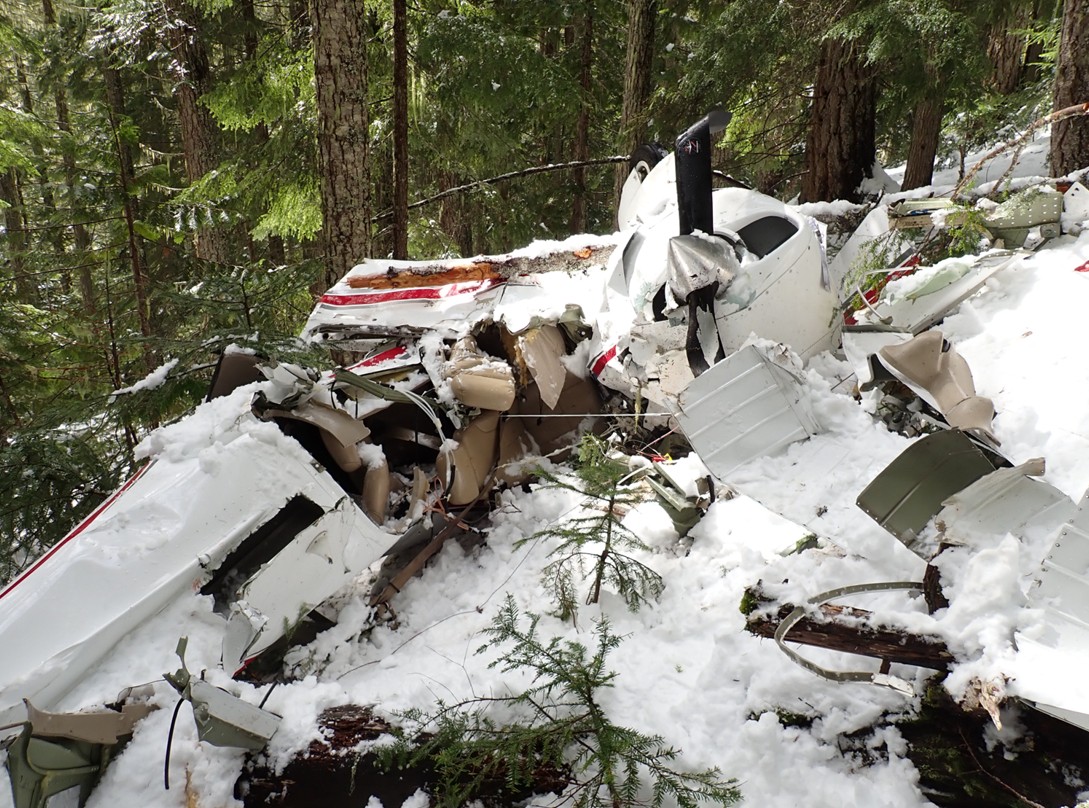
The investigation determined that the aircraft was intact before the collision, and all aircraft components were accounted for at the accident site. The damage to the leading edges of the aircraft wings and horizontal stabilizer was consistent with impacting trees. The flaps, flap selector lever, and flap position indicator were all found in the up position.
The engine throttle and mixture controls were found in the full-forward position; however, this may not be indicative of their exact setting before the accident sequence.
The aircraft wings, vertical stabilizer, and right horizontal stabilizer were found separated from the fuselage. The occupiable space within the aircraft cabin was compromised and the ceiling of the cabin was separated from the fuselage.
Mountain flying
Flying in mountainous terrain is best approached with specialized knowledge, thorough pre-flight planning, and disciplined in-flight decision making. The occurrence flight involved a low-level course reversal in a mountain valley, often referred to as a canyon turn. The available flight data indicates that several mountain flying best practices were not fully executed.
Transport Canada (TC) has published a pamphletTransport Canada, TP 2228-32E, Flying VFR in the Mountains (revised 28 June 2018). that provides guidance on mountain flying, including the importance of not flying down the middle of a valley and maintaining a position along one side to preserve an escape route with a safe turning radius. Similarly, the Civil Aviation Authority of New Zealand has published a booklet about mountain flying,Civil Aviation Authority of New Zealand, Mountain Flying (revised May 2021) at https://www.aviation.govt.nz/assets/publications/gaps/caa-gap-mountain-flying-may-2021-web.pdf (last accessed on 03 March 2026). which emphasizes that pilots should never position the aircraft in the middle of a valley because of the increased risk of not having enough space and time to complete a course reversal. The occurrence flight did not follow this practice. When the aircraft did transition to the south side of the valley from the middle, approximately 11 seconds before initiating the course reversal, it did not use all the lateral space available.
Turning in a confined space at low level requires both careful speed management and consideration of aircraft performance limitations. The course reversal was initiated at an airspeed of approximately 72 knots indicated airspeed (KIAS),Estimated indicated airspeed, based on available ground speed data and estimated winds. and speed decreased during the manoeuvre.The lowest calculated airspeed based on available data was approximately 45 knots true airspeed. Based on available data, the airspeed decreased below the flaps up stall speed for the aircraft in level flight.The flaps up, power off stall speed according to the aircraft’s pilot operating handbook is 53 knots calibrated airspeed (KCAS).
Aircraft flaps can be used during course reversals in confined spaces to reduce stall speed and decrease turn radius. A book titled Mountain FlyingS. Imerson, Mountain Flying, Third edition (revised 1998), p. 97. notes that the use of flaps up to the halfway setting can provide additional lift and help in reducing the turning radius without excessively increasing drag. The retracted state of the aircraft flaps post-occurrence indicates they likely were not used during the turn.
Guidance from both TCTransport Canada, TP 2228-32E, Flying VFR in the Mountains (revised 28 June 2018). and the Civil Aviation Authority of New ZealandCivil Aviation Authority of New Zealand, Mountain Flying (revised May 2021) at https://www.aviation.govt.nz/assets/publications/gaps/caa-gap-mountain-flying-may-2021-web.pdf (last accessed 20 January 2026). emphasizes that pilots flying in mountainous terrain should always maintain an escape route and should never fly over terrain that cannot be outclimbed. In this case, the aircraft was approaching rising terrain at an altitude lower than the upcoming terrain. The book Mountain Flying states: “Under NO circumstances should you try to fly up a canyon without sufficient altitude to cross the ridge at the head of the canyon while allowing for downdrafts.”S. Imerson, Mountain Flying, Third edition (revised 1998), p. 90. Although the aircraft was climbing, it did not achieve a safe traversing altitude before entering the valley, as recommended by TC’s pamphlet Flying VFR in the Mountains.Transport Canada, TP 2228-32E, Flying VFR in the Mountains (revised 28 June 2018).
The Transport Canada Aeronautical Information Manual (TC AIM) states: “The importance of proper training, procedures and pre-flight planning when flying in mountainous regions is emphasized.”Transport Canada, TP 14371E, Transport Canada Aeronautical Information Manual (TC AIM) AIR — Airmanship (02 October 2025), section 2.13, Flight Operations in Mountainous Areas, p. 410, at https://publications.gc.ca/collections/collection_2025/tc/T52-2-2-2025-2-eng.pdf (last accessed 04 March 2026). However, TC has no training requirements for flight operations, commercial or private, in mountainous areas. The TC Flight Instructor Guide - Aeroplane contains no references to flying in mountainous areas or valleys, and no exercises that cover course reversals in these areas.
As a result, the responsibility to acquire the skills and knowledge necessary for safe mountain flying rests with individual pilots and the air operators who authorize flight in mountainous areas. Without appropriate training, pilots may be ill-prepared to recognize and manage the unique risks associated with mountain flying.
In May 2012, the BC Coroners Service released a panel report on aviation deathsGovernment of British Columbia, “Coroners Service releases panel report on aviation deaths” (01 May 2012) at https://news.gov.bc.ca/releases/2012JAG0064-000580 (last accessed 20 January 2026). in which it stated: “It is recommended that Transport Canada develop standardized curricula for Mountain Flying Training and develop criteria for measuring students’ proficiency in reaching the acceptable standard.”
Survival aspects
The aircraft was equipped with an automatic fixed ELT capable of transmitting on 121.5 MHz and 406 MHz. The ELT functioned as intended, producing a signal that was relayed to the Joint Rescue Coordination Centre and assisted in locating the aircraft.
A first aid kit and survival kit were found among the wreckage. It was reported that a survival kit was not routinely carried on instrument training flights or on flights to the practice areas adjacent to CYXX, but it was required for flights to remote areas, such as the area in which the aircraft was found.
Chilliwack search and rescue personnel arrived at the aircraft approximately 2 hours and 41 minutes after ELT activation and found both aircraft occupants fatally injured. The occurrence was not survivable due to the impact forces.
TSB laboratory reports
The TSB completed the following laboratory reports in support of this investigation:
- LP030/2025 – NVM [non-volatile memory] Data Recovery - Various
- LP039/2025 – Performance Analysis
- LP046/2025 – Engine Teardown
Safety action taken
As a result of this occurrence, Chinook Helicopters (1982) Ltd. has taken the following actions:
- Adjacent to the dispatch whiteboard, a map was added on which pilots who are conducting flights into mountainous areas must provide their planned routing or area of operation.
- Flight instructors were provided with simulator training focused on flight in mountainous terrain.
- Flight instructors received a mountain flying ground briefing from an instructor with mountain flying experience.
- A debrief was held with all staff in relation to the occurrence.
Safety messages
Although the ELT functioned as designed in this occurrence, in cases where ELTs are not effective, a flight plan or flight itinerary may be the only means of locating a missing aircraft. Pilots are reminded that the CARs require a flight plan or flight itinerary to be filed when operating beyond 25 NM of their point of departure.
While guidance material is available from TC, there is no regulatory requirement in Canada for either private or commercial pilots to receive mountain flying training. As a result, it is incumbent upon pilots and air operators who conduct flights in mountainous areas to take measures that ensure they are adequately prepared for flights in this environment. Without such training, pilots may not be aware of the risks presented by course reversals in mountain valleys or of the techniques required to successfully perform these turns and the turn radius required by their aircraft.
This report concludes the Transportation Safety Board of Canada’s investigation into this occurrence. The Board authorized the release of this report on 04 March 2026. It was officially released on 18 March 2026.