
Main-track derailment
Quebec North Shore and Labrador Railway
Ore train BAL-481-F
Mile 25.4, Wacouna Subdivision
Near Saumon Station, Quebec
The Transportation Safety Board of Canada (TSB) investigated this occurrence for the purpose of advancing transportation safety. It is not the function of the Board to assign fault or determine civil or criminal liability. This report is not created for use in the context of legal, disciplinary or other proceedings. See Ownership and use of content. Masculine pronouns and position titles may be used to signify all genders to comply with the Canadian Transportation Accident Investigation and Safety Board Act (S.C. 1989, c. 3).
Summary
On 03 November 2024, at approximately 1956 Eastern Standard Time, 7 cars loaded with iron ore on train BAL-481-F derailed on the main track at Mile 25.4 of the Wacouna Subdivision near Saumon, Quebec. About 250 feet of main track was damaged. There were no injuries, and there was no environmental damage.
1.0 Factual information
1.1 The occurrence
On 03 November 2024, at approximately 1437,All times are Eastern Standard Time. Champion Iron’s ore train BAL-481-F (the train), a unit trainA unit train is a train carrying a single commodity (in this case, iron ore) in cars of similar type, length, and weight. operated by Quebec North Shore and Labrador Railway (QNS&L), departed Mai Station, Quebec, and was travelling southbound toward Sept-Îles, Quebec, on QNS&L’s Wacouna Subdivision. The train consisted of 3 locomotives (2 at the head end and 1 down two-thirds the length of the train) and 240 gondola cars loaded with iron ore. It weighed approximately 29 300 tons and was about 8600 feet long. The train was operated by a single locomotive engineer (LE).QNS&L ore trains are operated by a single employee.
After departing Mai, several pull-by inspections were performed without any reported defects. The train had also operated over the dragging equipment detector at Mile 29.7 and the hot box detector at Mile 59.3 without generating any alarms.
At approximately 1956, while travelling at about 22 mph, the train experienced a train-initiated emergency application of the train brakes when the head-end locomotive was in the vicinity of Mile 25.6. Just before the train came to a stop, the LE felt a jolt in the locomotive cab. The head end of the train came to a stop at Mile 25.4 (Figure 1).
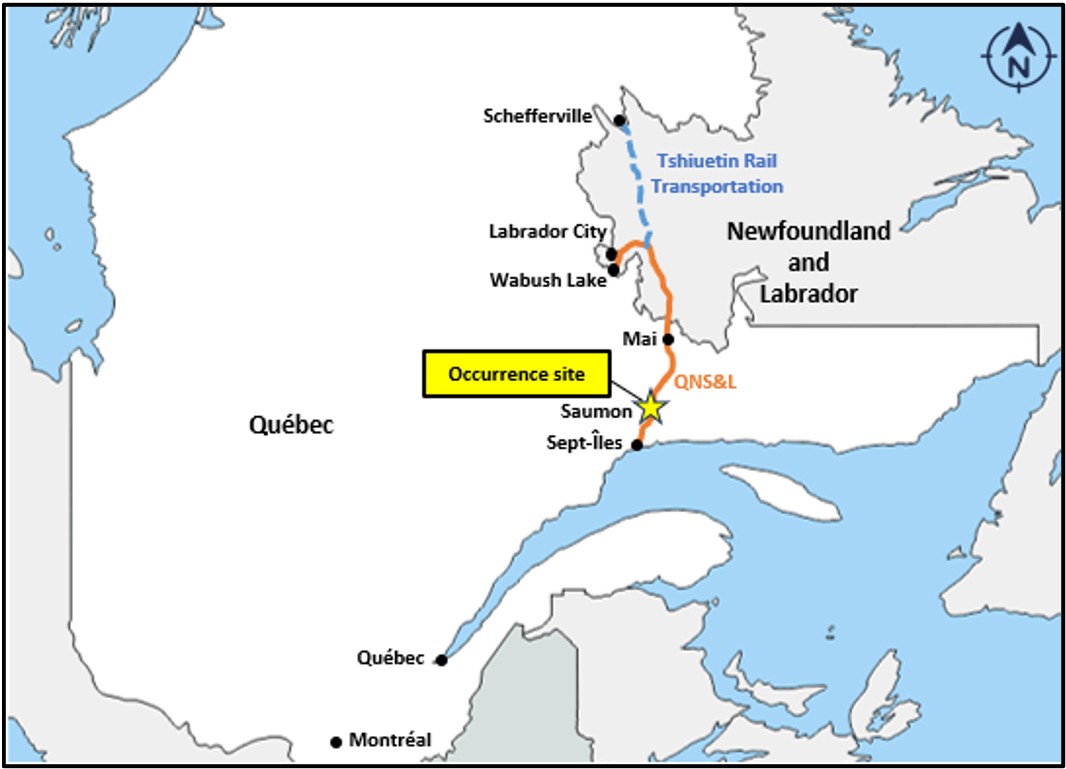
After taking the appropriate emergency measures, the LE determined that the first 7 cars had derailed. He also observed that a drawbar had dislodged from the 2nd car and that there was impact damage to the ends of the first 2 cars.
The main track was damaged over approximately 250 feet. There were no injuries, and there was no environmental damage.
The sky was cloudy, and the temperature was 0 °C.
1.2 Subdivision information
The Wacouna Subdivision is a single main track that connects Sept-Îles (Mile 8.9) to Emeril Junction, Newfoundland and Labrador (Mile 225.30).Train movements are governed by the centralized traffic control (CTC) system, as authorized by the Canadian Rail Operating Rules (CROR), and supervised by 2 rail traffic controllers (RTCs) located in Sept-Îles who share the territory.
The track is Class 3 according to Transport Canada (TC)–approved Rules Respecting Track Safety. The maximum allowable speed for freight trains is 40 mph.At QNS&L, maximum allowable speeds for ore trains are 40 mph for empty trains and 35 mph for loaded trains. Rail traffic on this subdivision consists of 9 trains per day (ore, freight, and passenger trains), for an annual tonnage of nearly 28 million gross tons.
1.3 Track information
In the vicinity of the occurrence, the track consists of 136-pound continuous welded rail. The rails on the east side, manufactured by Nippon Steel Corporation in 2022, were installed in the summer of 2024. In the direction of travel, there is a slight ascending grade of approximately 0.16%. Starting at Mile 26.66, there is a 6° left-hand curve over 485 feet, followed by a 130-foot tangent section and a 2° right-hand curve over 1775 feet (between Mile 25.66 and Mile 25.30).
The TSB investigation determined that the track had been inspected regularly by QNS&L and that no defects had been reported in the derailment area. The investigation established that the track was not a factor in the occurrence.
1.4 Recorded information
The TSB obtained the downloaded event recorder data from the head-end locomotives, the locomotive voice and video recorder (LVVR) data, and recordings of the radio communications. The TSB also collected relevant information on the track profile and hot box and dragging equipment detector readings along the route.
The data collected showed that, before the emergency application of the brakes on each car, the LE had just gradually reduced the dynamic braking force, in accordance with QNS&L operating practices. The train was then approaching the bottom of a descending grade and was about to climb an ascending section of track.
1.5 Locomotive engineer information
The LE operating the train was qualified for the position, was familiar with the territory, and met fitness and rest standards. He had been working for QNS&L since August 2022 and became qualified as an LE in July 2023.
1.6 Site examination
The A-end of the 1st car (IOCC 8153) derailed, and the car remained coupled to the head-end locomotives. The drawbar on the 2nd car (IOCC 11431) had dislodged from the draft sill but remained coupled to the 1st car (Figure 2).
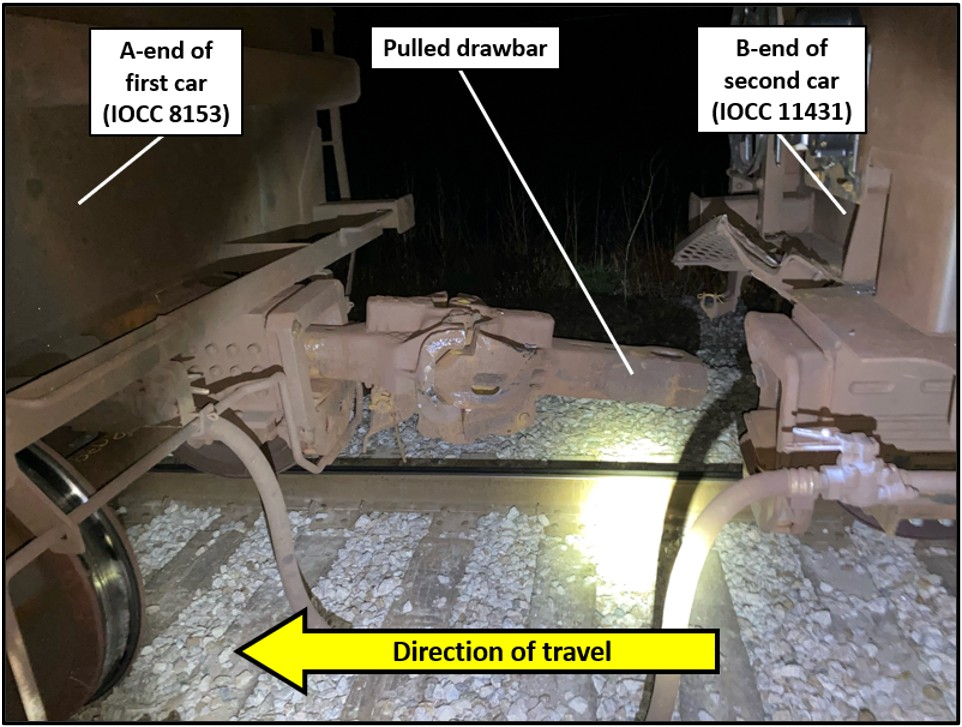
The 2nd car (IOCC 11431) had marks on the face of the striker at the B-end, resulting from the collision between the 2 parts of the train following the separation. The uncoupling devices and hand brake at this end of the car were also damaged, as well as the platform located under the hand brake wheel. The yoke located in the draft sill was broken.
The trucks of the first 7 cars of the train had derailed, and the east rail had rolled over to the field side for a distance of approximately 250 feet.
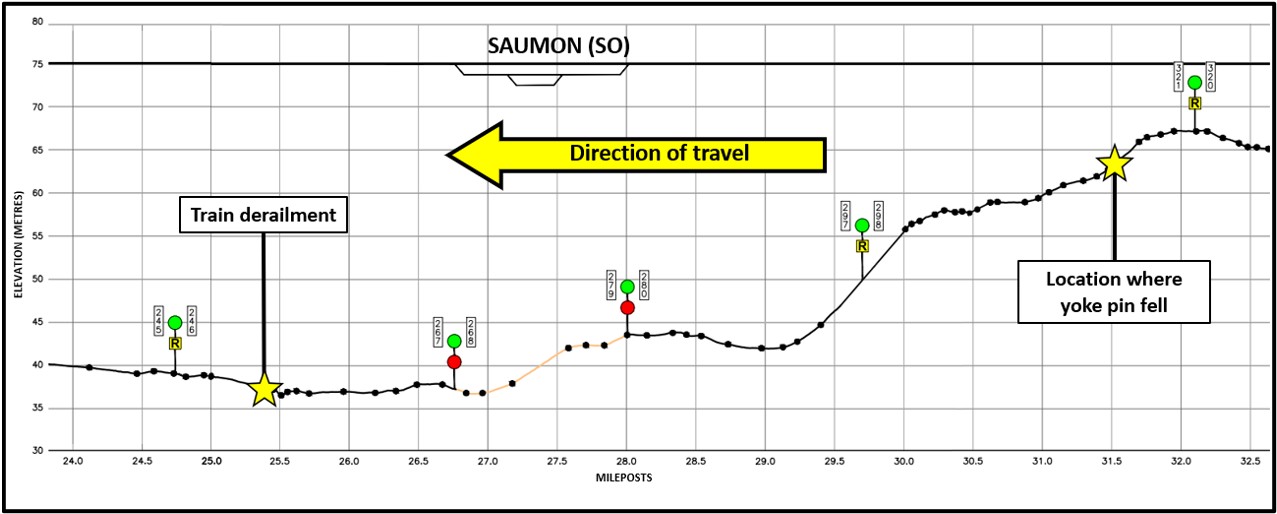
The pin connecting the drawbar to the yoke from car IOCC 11431 was found in the vicinity of Mile 31.5 (Figure 3) and showed no signs of damage or wear.
1.7 Examination of the coupler on car IOCC 11431
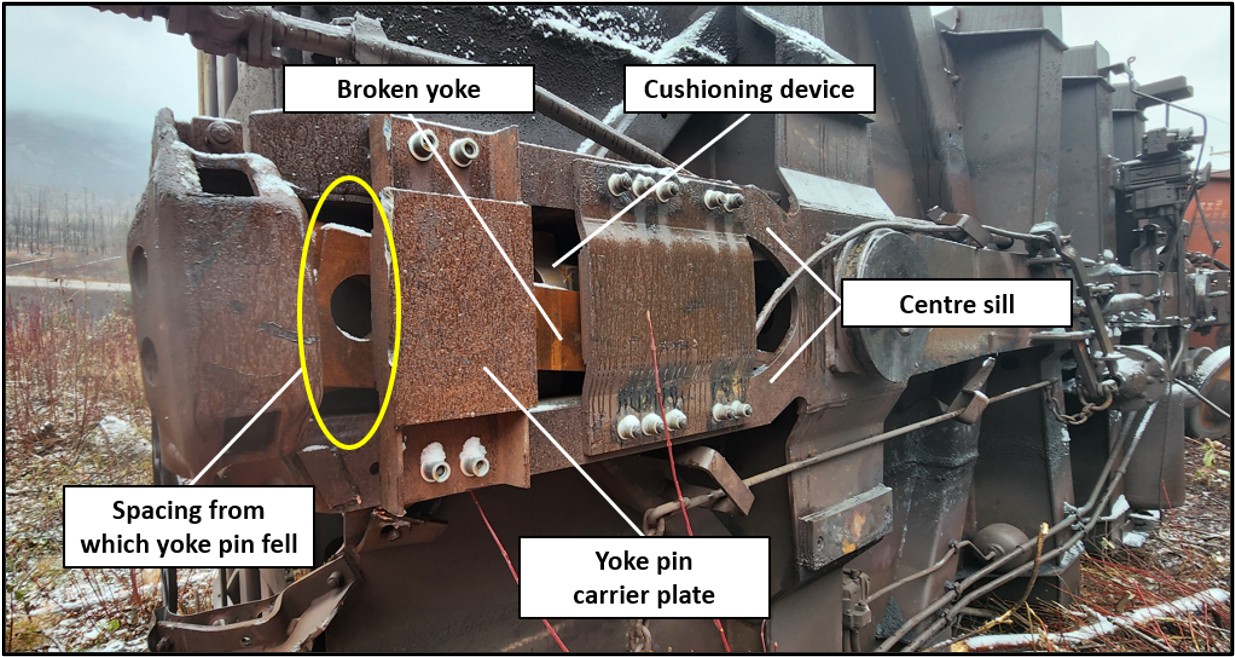
After the occurrence, most of the derailed cars were moved off the railway right-of-way so that regular service could be restored as quickly as possible. Car IOCC 11431 ended up on its side, allowing TSB investigators to get a closer look at the main components of the coupler at its B-end (Figure 4).
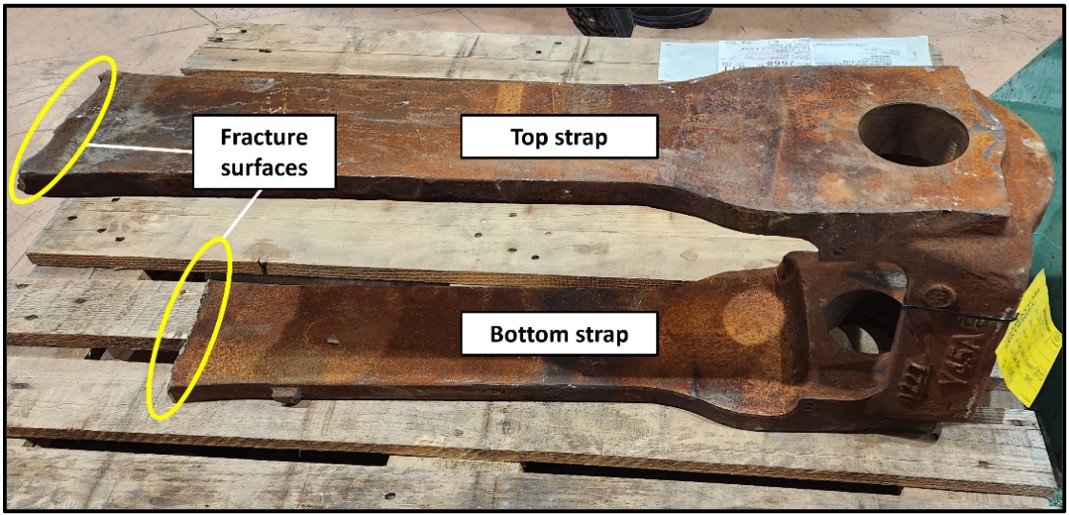
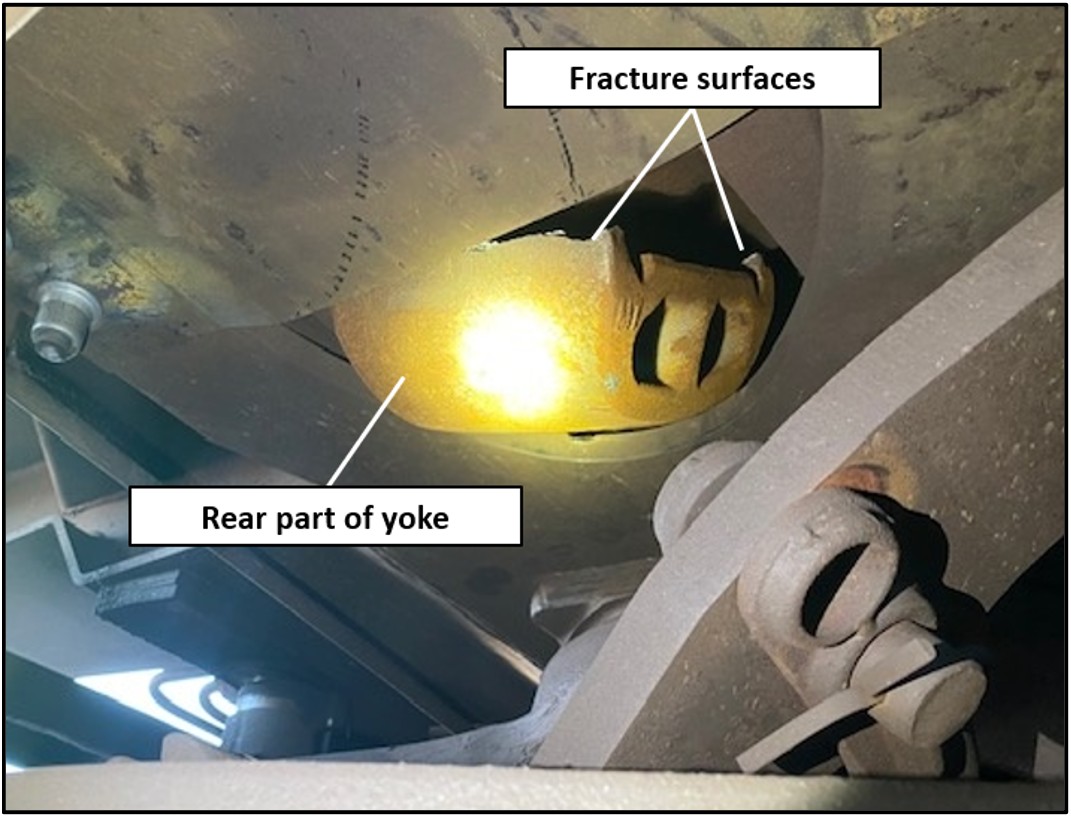
The coupler at the B-end of car IOCC 11431 was examined and it was determined that the yoke had broken near its rear part, at the end of the cushioning device (Figure 5).
The rear part of the broken yoke remained attached to the car (Figure 6).
The yoke, model Y45AE, was manufactured in March 2024 by railway equipment manufacturer McConway & Torley.
The coupler, a type F, is equipped with a drawbar attached to the yoke using a vertical yoke pin (Figure 7), which is held in place by a horizontal carrier plate (Figure 4).
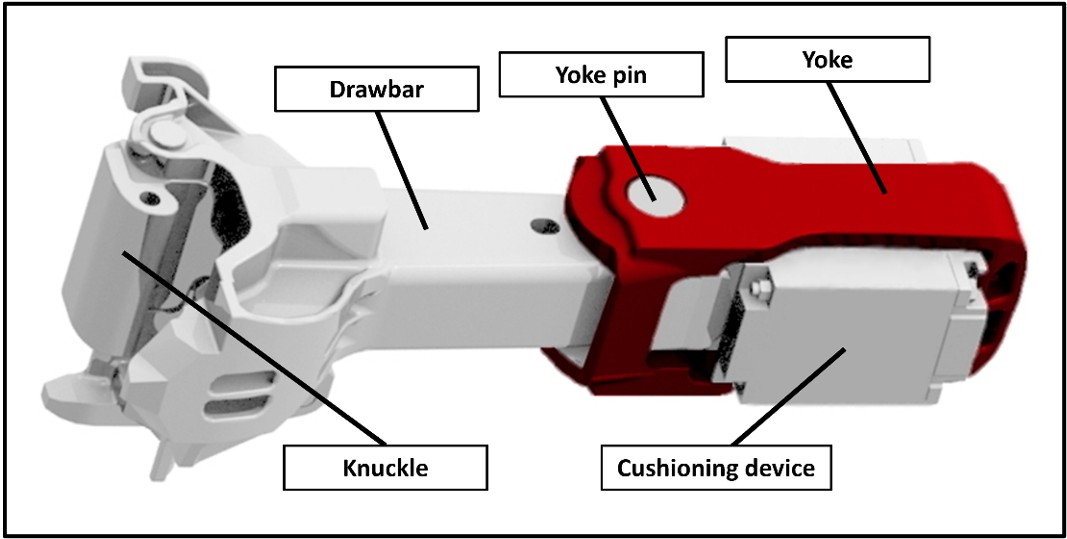
The carrier plate, yoke, and cushioning device are part of the coupler components that are attached to the inside of the centre sill under the car. The yoke pin acts as a pivot for the drawbar, giving this component some mobility on 2 axes of movement:
- Laterally, within the physical limits provided by the end of the centre sill, so that the cars can negotiate curves and switches more easily.
- Longitudinally, since the hole designed to receive the yoke pin is oblong in shape, so that the cushioning device can function as a damper by absorbing the stretching and compressing movements between the rail cars.
When the TSB investigators examined the car, the carrier plate that holds the yoke pin was removed so that the contact surface of the plate could be observed. The plate showed signs of wear extending to its front end (Figure 8).
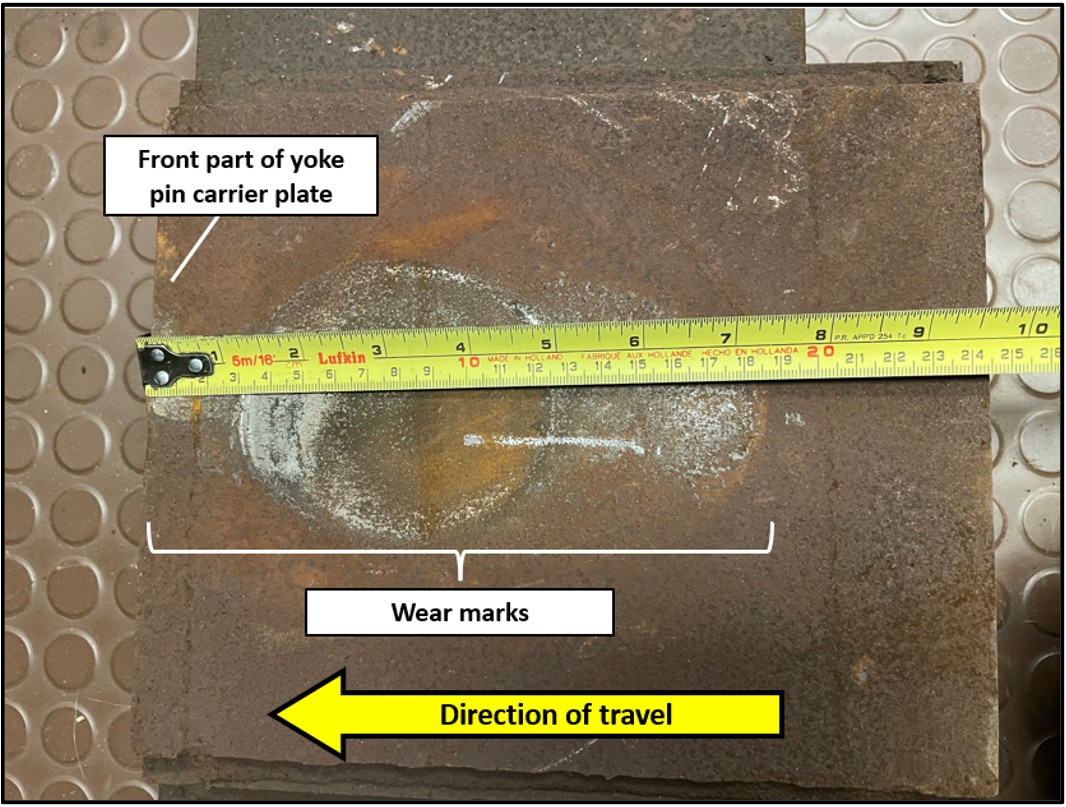
The front part of the broken yoke was recovered and sent to the TSB Engineering Laboratory in Ottawa, Ontario, for analysis. A new yoke from the same manufacturer, manufactured during the same period, was also selected and sent to the TSB laboratory for comparison purposes.
1.8 Rail car inspection and maintenance
At QNS&L, rail cars undergo a regular inspection at Sept-Îles Yard, when they return from the mine. Rail cars are also subject to quality control during maintenance and repair activities at the QNS&L shop.
According to QNS&L records, car IOCC 11431 underwent major repairs at the end of September 2024, approximately 4 weeks before the occurrence. Various components of the B-end coupler, including the yoke that broke, were replaced with new parts at that time.
1.9 Simulations of in-train forces
In-train forces are dynamic buff and draft forces applied to the rail cars and their components when the train is in motion.
The TSB conducted simulationsSimulations were performed using the Freight Train Operations Simulator (FTOPS) software. to determine the forces exerted along the train from Mile 40, before the yoke pin connecting the drawbar to the yoke fell off.
According to simulations carried out from this point, prior to the derailment, the coupler on car IOCC 11431 was subjected to maximum tensile and compressive forces of less than 200 kips, which is within the normal range of forces along the train.
1.10 Standards for coupler components
The design, manufacture, and examination of coupler components are governed by Association of American Railroads (AAR) specifications M-201, M-205, and M-211 of the Manual of Standards and Recommended Practices.The Railway Freight Car Inspection and Safety Rules, approved by Transport Canada, prescribe the minimum safety standards that apply to freight cars. Under these rules, railways must ensure that the freight cars they put in service are free of prescribed safety defects. In addition, cars exchanged between railways must comply with the Field Manual of the AAR Interchange Rules. Although most of QNS&L’s rail operations are conducted on a “captive” basis, i.e., without exchanging cars with other railways, the car component manufacturers from whom QNS&L purchases are required to comply with AAR specifications for the equipment they produce.
Type E, E/F, and F coupling components are cast parts that must comply with the following requirements:
- Coupler knuckles must be able to withstand a tensile load of 400 kips.One kip is equivalent to 1000 pounds of force.
- The yokes must be able to withstand a tensile load of 700 kips.
Yokes are manufactured through casting. Once removed from the cast, they undergo heat treatment and a visual inspection. This inspection mainly consists of examining the outer surface of the parts to detect visible defects such as cracks, pitting, burrs, and inclusions.The AAR specifications refer to the relevant acceptance criteria defined by the Steel Castings Research and Trade Association (SCRATA).
If minor surface defects are found, they are repaired, and the part is heat-treated again.
To validate the manufacturing process for these cast parts, at least one randomly selected representative sample is subjected to a series of tests each year, most of which are destructive. These tests include determining the internal solidity of the sample and evaluating the physical properties and chemical composition of the material as well as its performance.Impact resistance, tensile strength, chemical composition, and hardness.
The internal solidity of a sampled yoke is determined by sawing off cross-sections at 4 prescribed locations. The exposed surfaces of the resulting pieces reveal any internal defects, such as discontinuities, porosity and/or shrinkage. The size, shape, and location of the defects identified on each of these surfaces are then visually compared to standard reference photographs in the AAR specifications,Association of American Railroads, Manual of Standards and Recommended Practices, Section S: Casting Details, Specification M-211, section 3.1.4.4 and Appendix I, November 2016. and each surface is assigned a ratingThis severity rating is based on qualitative visual criteria and ranges from 1 (least severe) to 6 (most severe). representing the severity of the defects found.
The ratings assigned to exposed surfaces are assessed according to qualitative criteria established in the AAR specifications.Association of American Railroads, Manual of Standards and Recommended Practices, Section S: Casting Details, Specification M-211, section 3.1.4.5, November 2016. If the findings of these assessments meet these criteria, the manufacturing process for castings and the materials used are considered acceptable, and all parts produced using this process are deemed to comply with the requirements.
There is no AAR requirement for non-destructive testingA method of inspection, testing, or examination designed to detect defective characteristics in a component without altering its function or structure. (e.g., ultrasonic or radiographic testing) of manufactured parts to detect internal defects.
1.11 TSB laboratory analyses
The TSB laboratory conducted extensive examinations of the recovered portion of the yoke involved in this occurrence and of a comparison yoke manufactured by the same manufacturer during the same period.
The examinations and analyses performed included:
- Internal solidity tests
- Evaluation of material properties (hardness, chemical composition, and resilience)
- Visual inspection and dimensional validation
Visual examination of the yoke involved in this occurrence revealed that the 2 straps failed through brittle fracture near their rear part.The fracture surface was located approximately 19 mm from one of the 4 locations where a cross-section is required by AAR specifications to assess the internal strength of the part.
The assessment of the internal solidity of this yoke in accordance with AAR specificationsWith cross-sections at 4 specified locations. also determined that it complied with the prescribed standards. However, one of the 4 cross-sections could not be made at the exact location specified because that location was on the part of the broken yoke that had remained attached to the car and could not be recovered. This cross-section was therefore made on the yoke straps, approximately 51 mm from the location specified by the AAR, or approximately 32 mm from the fracture surface. Consequently, it is not possible to conclude with certainty that the yoke involved in this occurrence met the prescribed internal solidity tests.
As for the comparison yoke examined by the laboratory, it passed the internal solidity tests prescribed by AAR specifications at the 4 specified locations.
Evaluation of the physical properties and chemical composition of the material confirmed that both the broken yoke and the comparison yoke met AAR specifications.
Laboratory analysis concluded that the yoke had sustained a brittle fracture due to overload in 2 locations near the rear of its 2 straps, in an area subject to high stresses. The initial fracture occurred in the top strap, which was closest to the underside of the car body. This strap had porosityThat porosity had a total surface area of approximately 76 mm2. attributable to shrinkage that was not visible on the outer surface of the cast part. Following this initial fracture, because all the tensile forces on the yoke were concentrated on the bottom strap, the latter was unable to withstand the sudden overload and also failed. At this location, the applied stresses exceeded the material’s tensile strength, which was reduced due to internal porosity that had formed during casting of the part.
1.12 Other similar occurrence
On 08 January 2020, as part of its investigation into an occurrence where a knuckle made by another manufacturer failed during switching operations at Alyth Yard in Calgary, Alberta,TSB occurrence R19C0002. the TSB issued Rail Safety Advisory Letter 01/20 regarding inclusions and porosity in a coupler knuckle. The TSB stated that Transport Canada and the AAR may wish to follow up with the appropriate equipment manufacturers to ensure that vulnerabilities (such as porosity and inclusions) are not introduced into the knuckle castings during the manufacturing process. The AAR then contacted the knuckle manufacturer to discuss TSB’s safety advisory.
1.13 TSB laboratory report
The TSB completed the following laboratory report in support of this investigation:
- LP187/2024 – Draft gear yoke failure analysis
2.0 Analysis
The investigation determined that there were no track defects or problems with the train’s operation before the emergency application of the train brakes. Since the derailment occurred after the train separated, the analysis will focus on the factors that led to the pulled drawbar on car IOCC 11431.
2.1 The occurrence
On 03 November 2024, while iron ore train BAL-481-F was travelling on the main track at about 22 mph, the train experienced a train-initiated emergency application of the train brakes in the vicinity of Mile 25.6. Just before the train came to a stop at Mile 25.4, the locomotive engineer (LE) felt a jolt in the locomotive cab.
After taking the appropriate emergency measures, the LE determined that the first 7 cars had derailed. He also observed that a drawbar had dislodged from the 2nd car and that there was impact damage to the ends of the first 2 cars.
The marks indicated that the impact force was applied at an angle, amplifying the lateral force generated during the collision by pushing on the east-side rail, which then rolled over to the field side over approximately 250 feet. This led to the train derailing in the curve at Mile 25.4.
Finding as to causes and contributing factors
The train separated after the drawbar had dislodged from the 2nd car. The 2 parts of the train then collided, causing the rail on the east side to roll over and the first 7 cars to derail.
2.2 Examination of the coupler on car IOCC 11431
The 2nd car (IOCC 11431) had impact marks on the face of the striker at the B-end, resulting from the collision between the 2 parts of the train following the separation. The rear part of the yoke had broken at the end of the cushioning device. The coupler, the hand brake, and the platform located under the hand brake wheel were damaged.
The failure of the yoke caused it to move excessively in the draft sill. The yoke pin then moved beyond the carrier plate, causing it to fall onto the track. Because the drawbar was no longer connected to the yoke, it dislodged from the draft sill. The car, now detached from the rest of the train, became at risk of separating when the couplers would be stretched.
Finding as to causes and contributing factors
The drawbar at the B-end of the 2nd car became dislodged after the yoke broke, causing the yoke pin to move beyond the carrier plate. The pin then fell onto the track, causing the train to become uncoupled and susceptible to separation.
2.3 TSB laboratory analyses
The TSB laboratory examined the broken yoke and the comparison yoke.
Yokes are robust components whose design dates back several decades, with thousands in use throughout North America. No such occurrences, other than the one under investigation, are recorded in the manufacturer’s records or in the TSB database. Therefore, the probability of this type of occurrence recurring is relatively low.
The yoke in this occurrence sustained a brittle fracture due to overloading in an area subject to high stresses, where internal porosity was present. That porosity, which was not apparent on the surface of the cast part, could not be identified during the visual inspection of the yoke after manufacture. As a result, the tensile strength of this part of the yoke was reduced below the minimum strength required by Association of American Railroads (AAR) specifications. The yoke was therefore more susceptible to failure when subjected to the normal in-train forces.
Finding as to causes and contributing factors
The yoke had internal porosity in a high-stress area. That porosity, which likely formed when the part was cast, reduced the tensile strength of this section of the yoke, causing it to fail in service.
Laboratory tests determined that both the broken yoke and the comparison yoke met AAR requirements for composition, metallurgical hardness, and Charpy toughness. The comparison yoke also met AAR requirements for internal solidity. Therefore, these tests determined that the properties of the material used by the manufacturer to cast these parts were valid according to AAR specifications.
Inspection of coupler components after manufacture is primarily visual. This visual inspection cannot detect any hidden defects or internal defects that could compromise the structural integrity of the parts. No non-destructive testing, such as ultrasonic or radiographic testing, is performed or required by AAR specifications. Without such testing, it is impossible to detect the possible presence of inclusions or porosity inside manufactured components before they are put into service.
Finding as to causes and contributing factors
Given that couplers are not required by the AAR to undergo non-destructive testing, the internal porosity that caused the yoke to break was not identified after the part was manufactured.
2.4 In-train forces
Based on the TSB’s simulations of the in-train forces prior to the accident, the coupler on car IOCC 11431 was subjected to maximum tensile and compressive forces of less than 200 kips from Mile 40, which is within the normal range for a loaded ore train.
According to AAR specifications, yokes must withstand a tensile load of 700 kips.
Finding: Other
The in-train forces before the yoke broke remained within AAR specifications.
3.0 Findings
3.1 Findings as to causes and contributing factors
These are the factors that were found to have caused or contributed to the occurrence.
- The train separated after the drawbar had dislodged from the 2nd car. The 2 parts of the train then collided, causing the rail on the east side to roll over and the first 7 cars to derail.
- The drawbar at the B-end of the 2nd car became dislodged after the yoke broke, causing the yoke pin to move beyond the carrier plate. The pin then fell onto the track, causing the train to become uncoupled and susceptible to separation.
- The yoke had internal porosity in a high-stress area. That porosity, which likely formed when the part was cast, reduced the tensile strength of this section of the yoke, causing it to fail in service.
- Given that couplers are not required by the Association of American Railroads to undergo non-destructive testing, the internal porosity that caused the yoke to break was not identified after the part was manufactured.
3.2 Other findings
These findings resolve an issue of controversy, identify a mitigating circumstance, or acknowledge a noteworthy element of the occurrence.
- The in-train forces before the yoke broke remained within Association of American Railroads specifications.
4.0 Safety action
4.1 Safety action taken
The Board is not aware of any safety action taken following this occurrence.
This report concludes the Transportation Safety Board of Canada’s investigation into this occurrence. The Board authorized the release of this report on 18 March 2026. It was officially released on 31 March 2026.