
7 April 2026
Director General, Rail Safety and Security
Transport Canada
Enterprise Building, 14th Floor
427 Laurier Avenue West
Ottawa ON K1A 0N5
On 12 January 2026, VIA Rail Canada Inc. (VIA) passenger train VIA 14, carrying 115 passengers between Montréal, Quebec, and Halifax, Nova Scotia, was travelling eastbound on the main track of the Canadian National Railway Company (CN) Montmagny Subdivision, near Saint-Alexandre-de-Kamouraska, Quebec.In accordance with the TSB Policy on Occurrence Classification, TSB occurrence R26Q0001 has been classified as a Class 4 occurrence.
The train consisted of 2 locomotives located at the front and 19 passenger cars. It weighed 931 tons and was 1622 feet long. The train operating crew consisted of 2 qualified locomotive engineers—one operating locomotive engineer and one in-charge locomotive engineer. Ten employees were also on board the train to provide passenger service.
At approximately 0126,All times are Eastern Standard Time. near Mile 11.73, while the train was travelling at about 60 mph, the lead locomotive collided with 2 tractor-trailers that were parked on a lot adjacent to the railway tracks, with the rear portion of each trailer encroaching on the tracks (Figure 1).
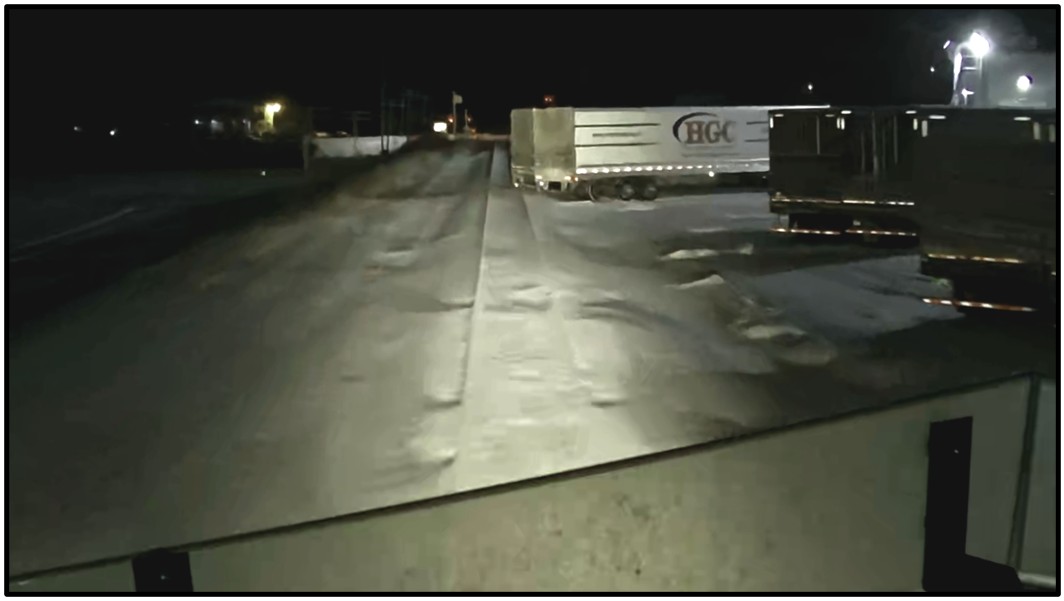
Following the collision, the 2 locomotives and the first 4 passenger cars derailed but remained upright. The train came to a stop about 500 feet further on, just before reaching a public crossing.The provincial highway 289 crossing. There were no injuries, either on board the train or in the tractor-trailers. The railway tracks were damaged over approximately 500 feet. The fuel tank of the lead locomotive was punctured, and its contents—just over 10 800 litres of diesel fuel—spilled out.
At the time of the occurrence, the temperature was -5°C, the sky was overcast, and it was snowing. The railway tracks were covered with a thin layer of snow.
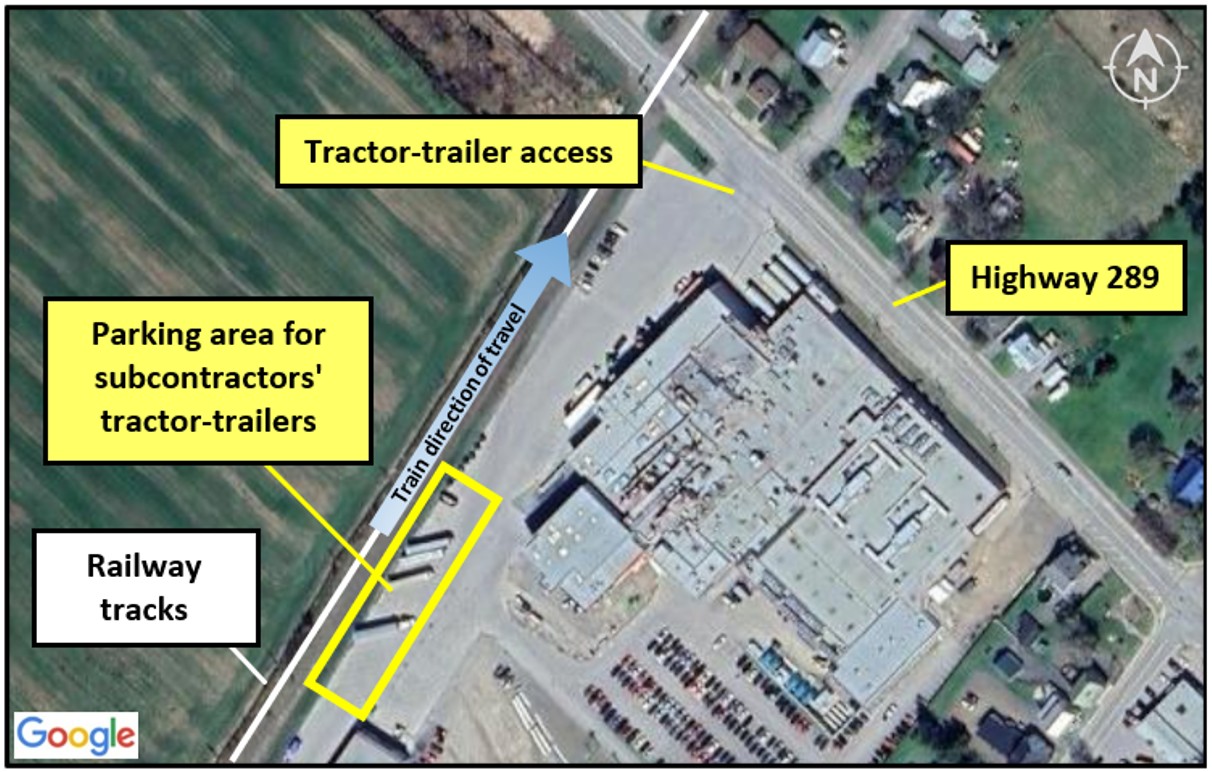
The lot where the tractor-trailersThe tractor-trailers belonged to separate subcontracting companies based in Ontario. were parked belongs to an animal processing company. Generally, drivers of subcontracted carriers park their trucks in the part of the lot adjacent to the south side of the railway tracks, as was the case in this occurrence. At that location, at the time of the occurrence, there was no fence or physical barrier delineating the area where tractor-trailers could park, nor were there any signs to that effect (Figure 2).
The 2 trucks had arrived separately at the company’s parking lot earlier that night.The first tractor-trailer had arrived shortly after midnight and the second, at about 0110. After parking their vehicles, the driversEach truck had 2 drivers on board. had settled into the sleeper cabs of their respective trucks to wait for the company to open, around 0630. In both cases, the drivers did not leave their vehicles to check the positioning of their trucks in the parking lot. Consequently, they did not realize that the rear portion of each trailer was within the railway right-of-way and encroaching on the railway tracks.
Since 2010, the TSB has recorded 6 occurrences in CanadaTSB occurrences R10D0071, R10T0198, R12C0133, R12W0060, R15E0089, and R17D0122. in which trains travelling on the main track collided with parked tractor-trailers that were encroaching on the railway tracks. Although this number is relatively low, the consequences of such an occurrence could be catastrophic, especially when passenger trains or trains carrying dangerous goods are involved.
Given the risks involved, Transport Canada may wish to consider adopting appropriate measures to enable the identification of locations where heavy vehicles could encroach on the railway right-of-way of main tracks and to ensure that preventive measures are implemented.
Transport Canada could also consider collaborating with provincial authorities to enhance training for heavy vehicle drivers and raise their awareness of railway infrastructure and the associated risks.
The TSB would appreciate being informed of what action, if any, will be taken in this regard.
Yours sincerely,
Original signed by
Vincenzo De Angelis
Director, Investigations – Rail/Pipeline
cc.
Senior Director, Operations Management, Rail Safety and Security
Transport Canada
Director, Policy, Legislative and Regulatory Affairs, Rail Safety and Security
Transport Canada
Director General, Multi-Modal and Road Safety Programs
Transport Canada
Vice President, Safety-Regulatory
Canadian National Railway Company
Senior Manager, Regulatory Affairs, Safety
Canadian National Railway Company
Director, Rail Safety Governance
VIA Rail Canada Inc.
Senior Director, Operations and Regulatory Affairs
Railway Association of Canada
Ministerial Coordinator for Rail Safety, Air and Rail Transport Directorate
Quebec Ministry of Transportation and Sustainable Mobility
Director, Government Relations and Administrative Support
Legal and Corporate Affairs
Société de l’assurance automobile du Québec
Director General
Quebec Trucking Association
Director, Commercial Safety and Compliance
Transportation Safety Division
Ministry of Transportation of Ontario