
Collision
Passenger vessel Navark Faucon Millenium and pleasure craft
St. Lawrence River
Longueuil, Quebec
The Transportation Safety Board of Canada (TSB) investigated this occurrence for the purpose of advancing transportation safety. It is not the function of the Board to assign fault or determine civil or criminal liability. This report is not created for use in the context of legal, disciplinary or other proceedings. See Ownership and use of content. Masculine pronouns and position titles may be used to signify all genders to comply with the Canadian Transportation Accident Investigation and Safety Board Act (S.C. 1989, c. 3).
Summary
During the afternoon of 27 June 2024, the passenger vessel Navark Faucon Millenium departed BouchervilleAll locations are in the province of Quebec unless otherwise indicated. for a 30-minute passage to the Old Port of Montréal. There were 38 passengers on board, and the crew consisted of 1 master and 1 deckhand.
Immediately after departure, the deckhand gave a safety briefing to all of the passengers in the deckhouse. The vessel proceeded along its route in the Chenal du Sud at a speed of approximately 20 knots, on an average heading of 245° true (T).
As the Navark Faucon Millenium was passing l’Îlot de la Baronnie, the master saw a pleasure craft at approximately 10° off the port bow, at a distance of 0.7 nautical miles (NM) and determined that a close port-to-port passing would occur. The master maintained the vessel’s speed and applied starboard helm, altering the vessel’s course by less than 5°.
Earlier that afternoon, pleasure craft 59E53608 had left Quai Marina in Repentigny with 6 occupants on board. The pleasure craft toured the Old Port of Montréal and started travelling back to Repentigny. On the return trip, the operator of the pleasure craft changed course toward Boucherville in the Chenal du Sud. The operator estimated the pleasure craft’s speed at 20 statute miles per hour (17.4 knots) with a heading of 060°T. However, the direction and strength of the wind and current, both of which were pushing the vessel from the stern, gave the impression of a lower speed; the pleasure craft was actually travelling at an average speed of 32 knots. The operator of the pleasure craft saw the Navark Faucon Millenium less than 1 minute before the collision and visually estimated that the pleasure craft and the Navark Faucon Millenium would pass each other port to port at a distance of approximately 7 m. He maintained an average heading of 060°T and a speed of 32 knots. Five seconds before the collision, when the vessels were approximately 0.06 NM (110 m) apart, the pleasure craft’s heading suddenly changed by 4° to port, directly into the path of the Navark Faucon Millenium. The pleasure craft struck the port bow of the Navark Faucon Millenium. Several passengers on the Navark Faucon Millenium were thrown onto the deck by the impact of the collision. The deckhand provided first aid to some of the injured passengers who were on the forward deck, while others were treated by uninjured fellow passengers.
The master reported the collision to Marine Communications and Traffic Services Québec and informed Croisières Navark Inc. of the occurrence. The Navark Faucon Millenium then went back to Longueuil, where the passengers disembarked. Some passengers were transferred to a local hospital for further treatment. After the vessel returned to Boucherville, it was temporarily removed from service for repairs.
The operator of the pleasure craft called 911 on his cellphone to report the collision. The pleasure craft was escorted to Pointe-aux-Trembles by CCGS Sipu Muin, which was nearby. After the occupants of the pleasure craft disembarked, 5 of them travelled by private vehicle to a local hospital for treatment.
The TSB investigation into this occurrence found that the Navark Faucon Millenium and the pleasure craft approached each other on nearly reciprocal courses with a combined speed of 52 knots, and neither operator significantly altered course or reduced speed. Consequently, there was little margin of safety in the passing situation. The pleasure craft veered suddenly toward the Navark Faucon Millenium 4 seconds before the anticipated passing, likely due to dynamic instability while planing at high speed. This, combined with the close passing distance, left insufficient time for either operator to respond to the unexpected change of course. Relying on his previous experience, the master of the Navark Faucon Millenium expected that the pleasure craft operator to take action to ensure a safe passing. This expectation resulted in him maintaining speed and only slightly altering course despite recognizing a risk of a collision. The pleasure craft operator’s assessment of the passing was based on his previous experience and did not account for the effects of dynamic instability. As a result, he maintained his course and speed without realizing that there was little margin of safety to account for unexpected events that might cause his course to change.
When passengers on board the Navark Faucon Millenium were thrown to the deck as a result of the collision, many of their injuries were exacerbated by physical hazards on board that had not been identified previously.
The TSB also identified other risks:
- Pleasure craft occupants who do not a wear a properly fitted personal flotation device or lifejacket while they are on an open deck are at risk of drowning if they go overboard from the vessel.
- If the crew complement specified on a vessel’s safe manning document is insufficient to respond to an emergency, there is a risk that the emergency response will not ensure the safety of the vessel’s crew and passengers.
- If on-board emergency procedures are incomplete and the practised drills do not reflect realistic emergencies, an actual emergency response may increase the risk to the vessel, crew, passengers, and others involved in the emergency.
Following this occurrence, the TSB issued a safety letter to Croisières Navark Inc. on 29 August 2024 regarding the physical safety of the Navark Faucon Millenium.
Transport Canada conducted an inspection of the hull, during which damage was found. A periodic inspection validated the temporary repairs to the hull, and a new deadline was set for permanent repairs to be made.
Following the TSB’s safety letter, Croisières Navark Inc. secured the bicycle rack to the deck of the Navark Faucon Millenium and updated the verbal pre-departure passenger safety briefing and the safety messages that play continuously on the television monitors on board each shuttle. During the 2025 season, Croisières Navark Inc. tested protective strips on exposed sharp edges to determine the best course of action for applying them to the company’s fleet. Handrails were added to the Navark Faucon Millenium during the 2024–2025 off-season.
Pleasure Craft Operator Competency Program
The TSB investigation into this occurrence revealed safety deficiencies related to the ability of pleasure craft operators to identify and manage risks in complex marine environments, such as waterways shared with other traffic.
In 2022, the TSB carried out a survey of Canadian licensed marine pilots in support of an investigation between a large commercial vessel and a pleasure craft. The results of the survey indicated that better education and training for pleasure craft operators was the most important factor to help reduce close-quarters situations and the risk of collision with commercial vessels.
Following a collision between the passenger ferry Svanoy and a pleasure craft in 2023, the Board issued the following safety concern about the adequacy of the PCOC program:
[T]he Board is concerned that the current requirements for training and certificating pleasure craft operators do not provide them with the depth of knowledge necessary for safe navigation on high-traffic waterways.
To learn a complex skill such as vessel navigation, a structured approach to training is needed. There are different ways to achieve the desired goal, but there are some recognized approaches that have become widespread as a result of their success, such as graduated licensing and periodic refresher training.
For this reason, the Board recommends that
the Department of Transport modify the Pleasure Craft Operator Competency Program to ensure that pleasure craft operators acquire and maintain a sufficient level of knowledge to be able to respond to the unique elements of the conditions in which they operate.
TSB Recommendation M26-01
1.0 Factual information
1.1 Particulars of the vessels
Name | Navark Faucon Millenium | No official name |
|---|---|---|
Official number | 843620 | 59E53608 |
Port of registry | Montréal, QC | Not applicable |
Flag | Canada | Canada |
Type | Passenger vessel | Donzi 28ZX |
Gross tonnage (GT) | 50.72 tonnes | Not applicable |
Length | 17.98 m | 8.53 m |
Breadth | 4.60 m | 2.29 m |
Design draft | 1.63 m | Not applicable |
Crew and passengers | 2 crew, 38 passengers | 6 occupants |
Built | 2020 | 2005 |
Propulsion | 2 diesel engines of 500 Hp each | 2 stern drive engines of 350 Hp each |
Authorized representative and owner | Croisières Navark Inc. | Private owner |
1.2 Description of the vessels
1.2.1 Navark Faucon Millenium
The passenger vessel Navark Faucon Millenium (Figure 1) is a single-deck, aluminum river shuttle providing walk-on service from BouchervilleAll locations are in the province of Quebec unless otherwise indicated. to Montréal. The vessel is operated by Croisières Navark Inc. as part of a fleet of over 20 vessels that transport passengers on the St. Lawrence River from mid-April through mid-October.
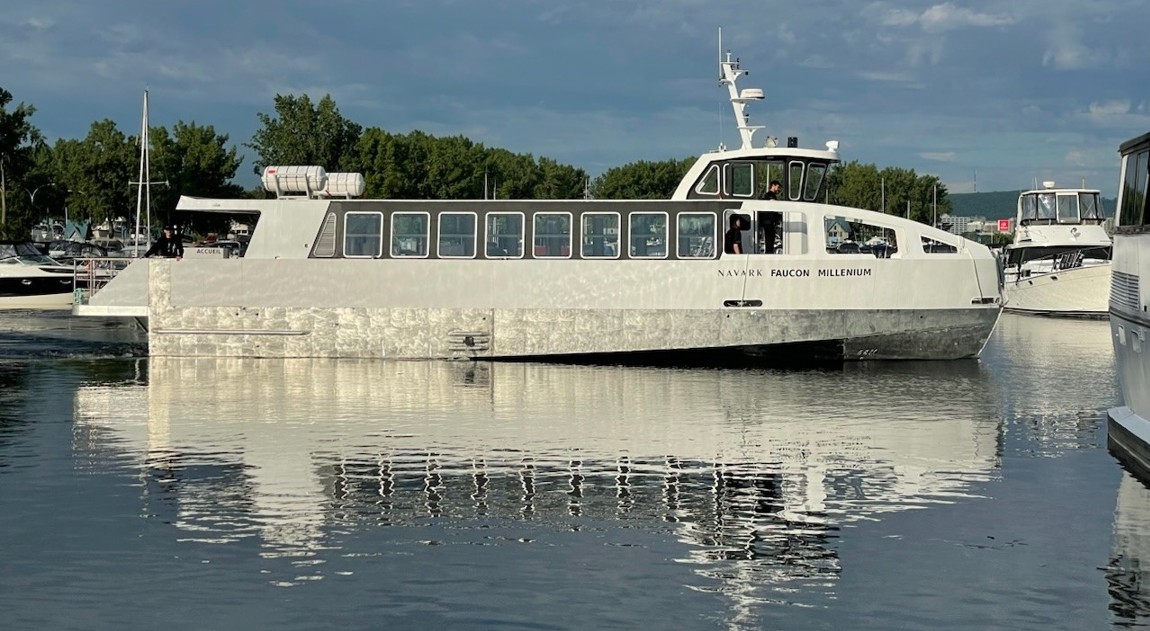
The Navark Faucon Millenium has an enclosed, windowed deckhouse that can accommodate 52 seated passengers. The deckhouse has 2 access doors: the forward access door leads to a partially covered deck, and the aft access door leads to an open aft deck with a bicycle rack.
The wheelhouse is situated forward of amidships, is elevated above the main deck, and is accessible from the deck house via steps. From the wheelhouse, crew members can see passengers on the forward deck. The hull below the main deck is divided into 5 compartments: the afterpeak, the engine room, 2 void spaces, and the forepeak. The vessel has 2 propellers and 2 rudders.
The bridge is equipped with all required navigational equipment, including a global positioning system (GPS), an X-band radar, an automatic identification system, and an electronic chart system. The vessel is also equipped with 2 very-high frequency radiotelephones and a public announcement system.
The Navark Faucon Millenium is certified by Transport Canada to carry 47 passengers with 2 crew members. It is equipped with two 45-person inflatable life rafts located on top of the deckhouse, as well as other required life-saving equipment (Appendix A). The vessel carries the required certificates for a vessel of its class and intended voyage.
1.2.2 Pleasure craft
Pleasure craft 59E53608 was a Donzi 28ZX (Figure 2), constructed of fibreglass and purchased by the owner in 2022. It had a modified V-shaped hull, which allows the craft to rise up from the water as it gains speed. This results in less drag and higher speeds (also known as planing).
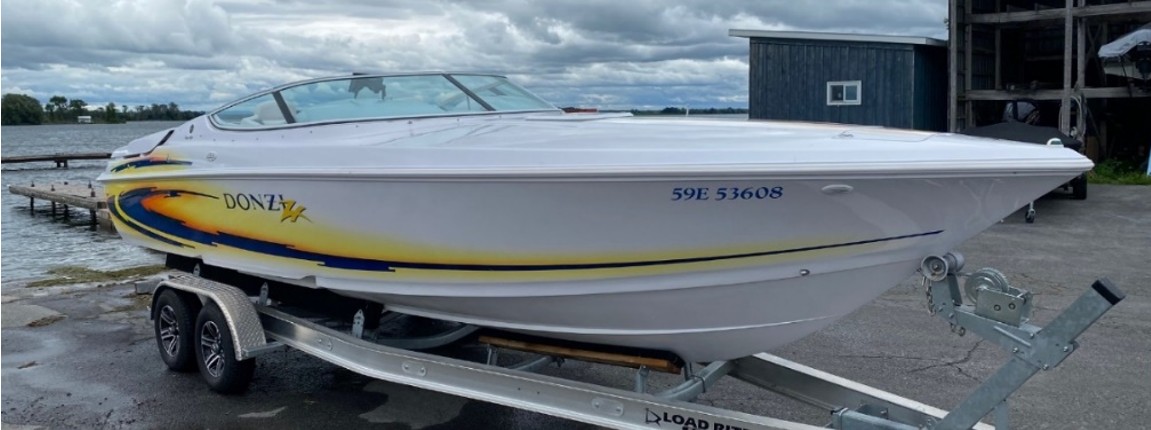
The cockpit included a helm station on the forward starboard side with a helm chair, another chair on the forward port side, and a bench for 4 people at the back (Figure 3). A companionway led from the cockpit to an enclosed forward compartment with a V-berth and additional seating inside.

The helm station included a navigation console with a steering wheel, 2 engine throttles for the 2 stern drives (known as inboard / outboard engines), a GPS / plotter / depth finder unit, and a manually operated horn. There was a speedometer on the dashboard that measured speed through the water. The pleasure craft carried personal flotation devices (PFDs) for all occupants on board, as required.
1.3 History of the voyage
1.3.1 Navark Faucon Millenium
On 27 June 2024, at approximately 1400,All times are Eastern Daylight Time (Coordinated Universal Time minus 4 hours). the Navark Faucon Millenium docked at Longueuil for a scheduled crew change. The crew, consisting of a master and a deckhand, boarded the vessel, which then departed for Boucherville. The vessel docked at Boucherville and embarked passengers as scheduled. Around 1446, the Navark Faucon Millenium departed for the 30-minute passage to the Old Port of Montréal with 38 passengers on board.
Immediately after departure, the deckhand gave a verbal safety briefing to all passengers in the deckhouse before allowing them to access the forward and aft decks. The vessel proceeded into Chenal du Sud at an approximate speed of 20 knotsAll speeds in this report are speed over ground, obtained from the Navark Faucon Millenium’s automatic identification system (AIS) and the pleasure craft’s global positioning system (GPS). on an average course of 245° true (T). At about 1455, when the vessel cleared l’Îlot de la Baronnie (Figure 4), the master saw the pleasure craft about 10 ° off the vessel’s port bow at a distance of 0.7 nautical miles (NM) and determined that a close port-to-port passing would occur.
The master maintained the vessel’s speed and applied starboard helm, altering the vessel’s course by less than 5°.
At 1455:50, the pleasure craft struck the Navark Faucon Millenium’s port bow.

Several passengers on the Navark Faucon Millenium were thrown onto the deck with the force of the collision. The vessel’s bicycle rack and a stroller shifted on the aft deck, partially blocking the aft deckhouse exit. The deckhand provided first aid to some of the injured passengers who were on the forward deck, while others were treated by uninjured fellow passengers. At approximately 1457, the master reported the collision over the vessel’s very high frequency (VHF) radiotelephone to Marine Communications and Traffic Services Québec. The master then informed Croisières Navark Inc. of the occurrence using a company cellphone. The Navark Faucon Millenium then left the occurrence area for Longueuil. The company requested that the Navark XL5, another passenger vessel in the fleet, go to the occurrence site to assist.
At 1505, the Navark Faucon Millenium docked at Longueuil and the passengers disembarked. Some passengers were transferred to a local hospital for further treatment. The rest of the passengers were given the option to continue their voyage to Montréal on another Croisières Navark Inc. vessel, or to reboard the Navark Faucon Millenium to return to Boucherville. At approximately 1530, the Navark Faucon Millenium arrived at Boucherville where it was temporarily removed from service for repairs.
1.3.2 Pleasure craft 59E53608
On 27 June 2024, at approximately 1320, pleasure craft 59E53608 departed from Quai Marina in Repentigny with 6 occupants on board. They toured the harbour in the Old Port of Montréal, took on fuel at Longueuil, and proceeded toward buoy M177 to the west. Around 1454, the pleasure craft altered course toward Boucherville in the Chenal du Sud after passing buoy M177. The pleasure craft operator estimated his craft’s speed at 20 statute miles per hour (17.4 knots) on a course of 060°T. However, data obtained by the TSB from the pleasure craft’s GPS indicate that the pleasure craft was operating at an average speed of 32 knots.The direction and force of the wind, which were predominantly at the stern, and the current of the river, which was also astern, gave the impression of a lower speed and of almost no wind.
At approximately 1455, the pleasure craft operator saw the Navark Faucon Millenium. He visually estimated that the craft and passenger vessel would pass each other port-to-port at a distance of approximately 7 m. He maintained an average course of 060°T and a speed of 32 knots. At 1455:40, 15 seconds before the collision, the pleasure craft and passenger vessel were 0.12 NM (225 m) away and were maintaining their courses to pass clear of each other (Figure 5).
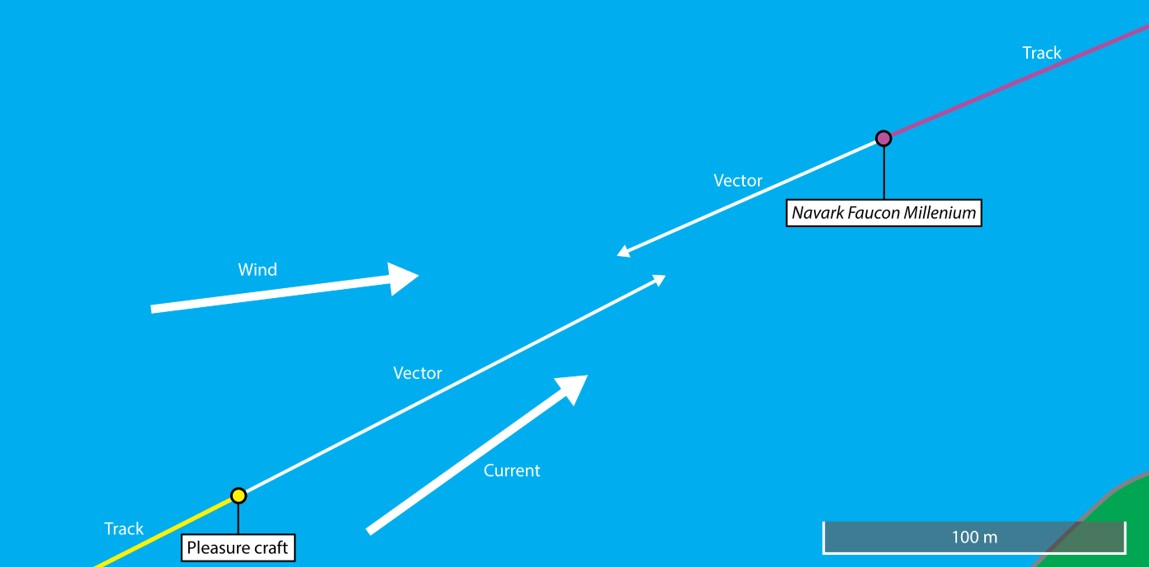
At 1455:45, when the distance between the vessels was approximately 0.06 NM (110 m), the pleasure craft’s course suddenly changed by 4° to port, directly into the path of the Navark Faucon Millenium (Figure 6). The investigation found no evidence that operator input caused the unexpected alteration to port.
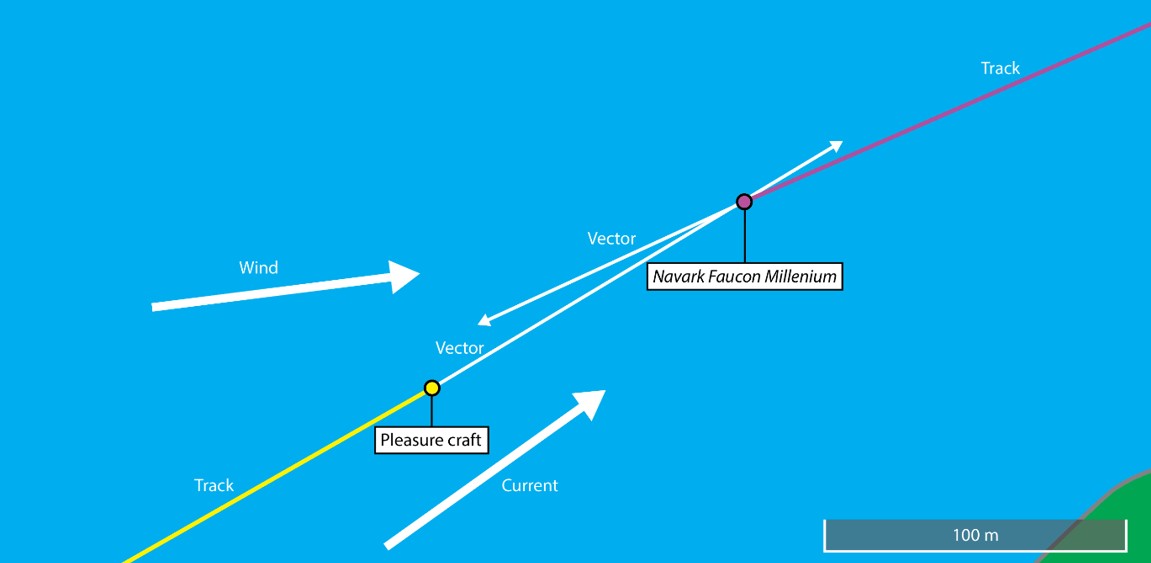
Five seconds later, the pleasure craft struck the Navark Faucon Millenium’s port bow and came to a stop. The occupants of the pleasure craft were thrown out of their seats by the impact but remained inside the pleasure craft. The pleasure craft operator assessed the occupants’ injuries. He noticed that the Navark Faucon Millenium had left the scene. At 1501, the pleasure craft operator called 911 on his cellphone to report the collision. His call was transferred to the Maritime Rescue Sub-Centre (MRSC) Québec; when asked if the occupants needed an ambulance, the pleasure craft operator indicated that an ambulance was not required. At approximately 1506, the passenger vessel Navark XL5 arrived on scene.
At approximately 1510, the Canadian Coast Guard Ship (CCGS) Sipu Muin arrived on site as tasked by MRSC. The Navark XL5 was released by MRSC and departed. The CCGS Sipu Muin escorted the pleasure craft to Pointe-aux-Trembles. After disembarking the vessel, 5 of the pleasure craft occupants went to a local hospital by private vehicle to seek treatment.
1.4 Environmental conditions
At the time of the occurrence, the sky was partially overcast and visibility was approximately 9 NM. There was a westerly wind of 15 to 20 knots. The current was northeasterly at approximately 4 knots. The wave height at the occurrence location was approximately 0.5 m.
The air temperature was 19.2 °C, and the water temperature was 19.5 °C.
1.5 Injuries
1.5.1 Navark Faucon Millenium
Several passengers were thrown to the vessel deck by the impact of the collision, which resulted in injuries ranging from minor to severe. Nine of the 38 passengers required transfer to a local hospital for further medical assessment and treatment.
Passenger injuries were exacerbated by sharp edges at the base of the vessel’s bulwark stanchions, the exposed edge of the lifebuoy cradle, an unsecured stroller, and the bicycle rack.
1.5.2 Pleasure craft 59E53608
As a result of the collision, 5 of the pleasure craft occupants sustained injuries ranging from minor to severe that were treated in hospital.
1.6 Damage to vessels
1.6.1 Navark Faucon Millenium
The Navark Faucon Millenium sustained minor damage near its port forward access gate (Figure 7) and inside its bulwark.
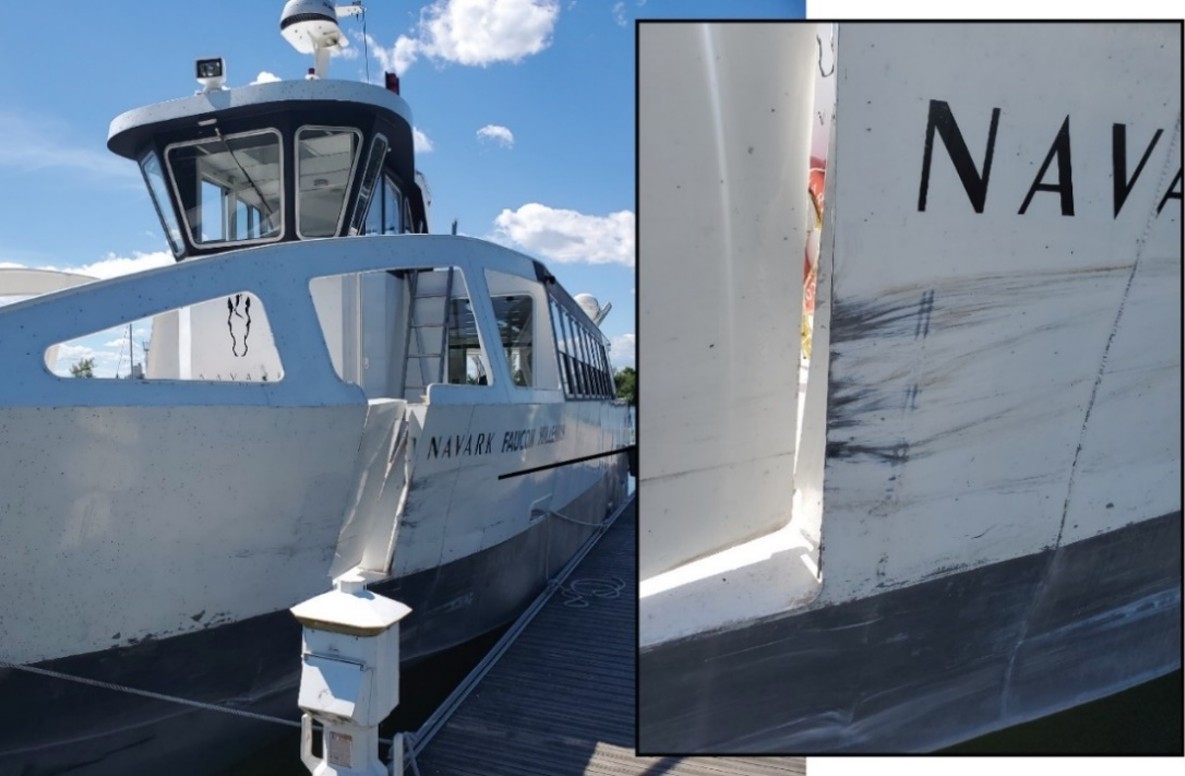
1.6.2 Pleasure craft
The pleasure craft was declared a constructive total loss, sustaining major damage to the bow (Figure 8), compression fractures along the port side from bow to stern, and damage below the waterline (Figure 9).
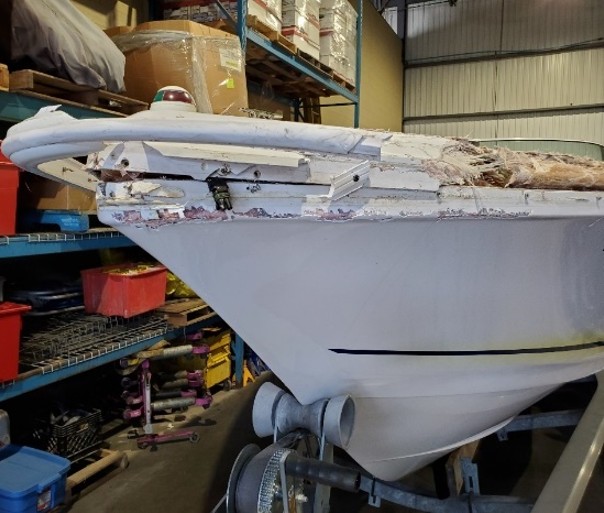
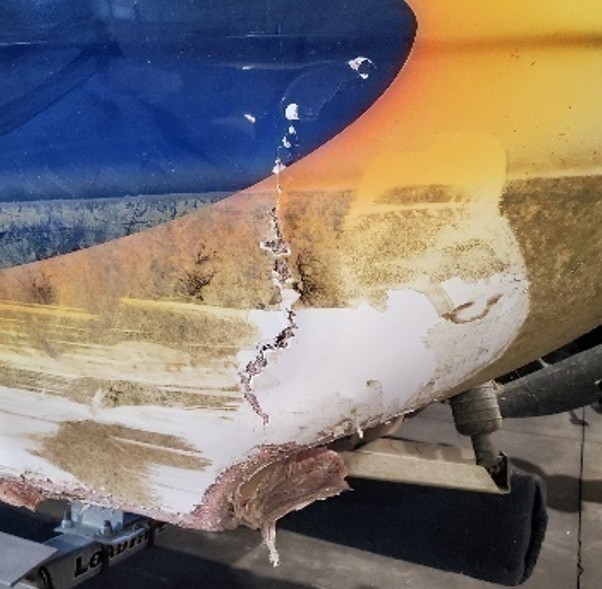
1.7 Certification and experience
1.7.1 Navark Faucon Millenium
The master held a certificate of competency as a Master, Limited for a vessel of less than 60 GT. This certificate permitted him to operate specific vessels on a specific voyage, which in this case included 6 of Croisières Navark Inc.’s passenger vessels between the Port of Montréal and Cap Saint-Michel. The master had completed Marine Emergency Duties (MED) courses A1, B1, and B2 in 1994. He had over 30 years of experience navigating on the St. Lawrence River and had worked with the company since 2022.
The deckhand held a certificate in marine basic first aid and had taken a MED course on seasonal passenger vessel safety for non-certificated personnel in April 2024. He had worked seasonally for Croisières Navark Inc. since September 2023. In May 2025, he took a MED course on domestic vessel safety. The deckhand had 20 years of non-commercial marine experience.
1.7.2 Pleasure craft
The pleasure craft operator held a Pleasure Craft Operator Card (PCOC), as required, and had over 20 years of experience in recreational boating on the St. Lawrence River.
1.8 Minimum safe manning
A safe manning document (SMD) is a document that Transport Canada (TC) issues to authorized representatives of vessels. The document, required since 2007, sets out the minimum number of qualified persons needed to operate a vessel. It also lists the minimum certification requirements for each member of the complement.Transport Canada, “Apply for or renew a Safe Manning Document,” at https://tc.canada.ca/en/marine-transportation/seafarer-certification/issuing-safe-manning-documents (last accessed on 22 April 2026). These requirements are based on the Marine Personnel Regulations.Transport Canada, SOR 2007/115, Marine Personnel Regulations (as amended 20 December 2023).
TC determines the minimum crew complement on board a vessel to ensure safe vessel operation. As part of its determination for passenger vessels, TC assesses 4 operational scenarios: normal, emergency, evacuation, and post-abandonment. The highest number of crew members needed in any 1 of these scenarios determines the minimum safe manning level for the vessel. An SMD is then issued, specifying the minimum number of crew members required on board, their minimum levels of certification, and a description of the voyages the vessel is permitted to undertake with that minimum crew complement. TC uses a standard form, entitled the Minimum Safe Manning Evaluation Form, to document each assessment.Transport Canada, “Annex A / B – Minimum safe manning evaluation form”, document no. 82-0792AE (2109-01). This form can be requested via TC’s website “Apply for or renew a Safe Manning Document,” at https://tc.canada.ca/en/marine-transportation/seafarer-certification/apply-renew-safe-manning-document/you-apply (last accessed on 22 April 2026).
In February 2023, TC issued an SMD for the Navark Faucon Millenium based on the vessel’s sister ship, the Navark XL5. TC did not use the Minimum Safe Manning Evaluation Form to determine the minimum crew complement for the Navark XL5; instead, TC took an evaluation it had conducted for a similar vessel in a similar condition (e.g., type, number of passengers, voyage waters) and applied it to the Navark XL5.
The SMD for the Navark Faucon Millenium specified that 2 crew members—the master and another crew member—must be on board when the vessel is carrying 47 passengers or fewer.
In April 2024, TC revised its internal policy to establish the National Safe Manning Committee to ensure that all new vessels would be evaluated to the same standard across all regions. According to TC, this ensures that all new vessels will be independently evaluated by a committee (instead of by an individual) using the Minimum Safe Manning Evaluation Form.
1.9 Emergency procedures
Forethought and planning are needed to safely manage marine emergencies. Emergency procedures record this planning and act as a reference guide for the crew when practicing emergency response. The emergency procedures detail the duties and responsibilities of personnel managing the emergency.At the time of the occurrence, the Navark Faucon Millenium had a documented set of operating procedures. Since the Marine Safety Management System Regulations came into force in June 2024, the vessel has been required to have a safety management system. A safety management system is an internationally recognized framework that allows companies to identify hazards, manage risks, and make operations safer—ideally before an accident occurs. Emergency procedures should reflect the specific characteristics of the vessel and each emergency situation, and consider the feasibility of all steps of a given response to ensure that the crew are able to perform the procedures as described.
Based on the SMD issued by TC, Croisières Navark Inc. developed proceduresCroisières Navark Inc., Navark Faucon Millenium – Plan d’évacuation (May 2020) [in French only]. specific to the Navark Faucon Millenium. One of these, a procedure in the event of a medical emergency or accident, instructed the crew to offer first aid, call 911 or the Canadian Coast Guard, and to stay with the injured person or persons if possible.
As required by TC, the company had also developed evacuation procedures, which it referred to as the vessel’s evacuation plan. TC noted the existence of the evacuation plan on 09 June 2020, but there is no formal process to validate whether the procedures contained within the plan meet regulatory requirements.Transport Canada, C.R.C., c.1436, Life Saving Equipment Regulations (as amended 20 December 2023). The TSB has previously issued a recommendation to TC to develop such a validation process (see section 1.18).
The evacuation plan contained 3 scenarios: a fire, a grounding, and a collision. For all 3 scenarios, the plan stipulated that [translation] “The master and crew will attempt to maintain order and calm. If abandoning the boat is necessary, they will attempt to bring the boat to the nearest quay or to a known safe grounding site, if conditions permit.”Croisières Navark Inc., Navark Faucon Millenium – Plan d’évacuation (May 2020), p. 9. If required to launch the life rafts, the deckhand would need to climb on top of the deckhouse, deploy 1 of the life rafts, then bring it to the muster station while also managing passengers and helping them don their lifejackets on the main deck. The deckhand would then have to repeat the process for the 2nd life raft.
The collision scenario specifies the steps for an evacuation using the life rafts but does not include instructions to account for the passengers, verify the state of the vessel, or give assistance (if necessary) to the other vessel.Part 6, section 148 of the Canada Shipping Act, 2001 stipulates the duty of masters in a collision. The section states: 148 If vessels collide, the master or person in charge of each vessel shall, if and in so far as they can to do so without endangering their vessel, crew or passengers, (a) render to the other vessel, its master, crew and passengers the assistance that may be necessary to save them from any danger caused by the collision, and to stay by the other vessel until the master or person has determined that it has no need of further assistance [….]
As part of the emergency procedures, Croisières Navark Inc. organized and practised tabletop and practical emergency drills, as required,Transport Canada, SOR/2010-83, Fire and Boat Drill Regulations (as amended 20 December 2023). with the crew of each vessel within the company fleet. Each drill consisted of a single-event emergency such as person overboard or fire.
The investigation found no evidence that TC observed the required drills or provided feedback to the crew. Practising realistic drills allows crews to revise and refine how emergency procedures are carried out, including the opportunity to increase manning levels, change locations of emergency equipment, and change roles and responsibilities.
Previous TSB investigations into accidents on board passenger vessels have revealed issues with emergency management,TSB marine transportation safety investigation reports M22C0231 and M22A0258. including crew members being given more than one role to carry out simultaneously during an emergency response.
1.10 Canadian regulations
1.10.1 Collision Regulations
The International Regulations for Preventing Collisions at Sea, 1972 (COLREGs) establish, among other things, the rules of conduct to follow at sea when a risk of collision exists between vessels. Governments or states may adopt special rules for their waterways. These rules have been adopted by Canada as the Collision Regulations and “apply to all vessels upon the high seas and in all waters connected therewith navigable by seagoing vessels.”Transport Canada, C.R.C. c. 1416, Collision Regulations (as amended 07 June 2023), Schedule 1: International Regulations for Preventing Collision at Sea, 1972 with Canadian Modifications, Rule 1(a).
For the safety and conduct of vessels in navigable waters, several Collision Regulations rules require that, among other things:
- “Every vessel shall at all times proceed at a speed so [it] can take proper and effective action to avoid a collision and be stopped within a distance appropriate to the prevailing circumstances and conditions.”Ibid., Rule 6. When determining a safe speed, consideration is given to visibility, the density of traffic, the manoeuvrability of the vessel with special reference to stopping distance and turning ability in the prevailing conditions, and the limitations of radar.
- “Any alteration of course and/or speed to avoid collision shall, if the circumstances of the case admit, be large enough to be readily apparent to another vessel observing visually or by radar; a succession of small alterations of course and/or speed should be avoided.”Ibid., Rule 8(b).
- “If necessary to avoid collision or allow more time to assess the situation, a vessel shall slacken speed or take all way off by stopping or reversing [its] means of propulsion.”Ibid., Rule 8(e).
- “When two power-driven vessels are meeting on reciprocal or nearly reciprocal courses so as to involve risk of collision, each shall alter […] course to starboard so that each shall pass on the port side of the other.”Ibid., Rule 14(a).
- “When a vessel is in any doubt as to whether such a situation exists [it] shall assume that it does exist and act accordingly.”Ibid., Rule 14(c).
1.10.2 Vessel Operation Restriction Regulations
The Department of Transport regulates navigation on Canada’s lakes, rivers, and waterways to ensure navigation safety and protect the marine environment. TC officials work with local governments to address boating safety concerns, such as excessive speed, and environmental risks, such as shoreline erosion and water quality, by placing restrictions on vessel speed and the types of activities vessels can engage in, setting hours of operation, and authorizing types of vessel propulsion. These measures are incorporated into the Vessel Operation Restriction Regulations.Transport Canada, SOR/2008-120, Vessel Operations Restriction Regulations (as amended 08 December 2023).
Schedule 6 of the Vessel Operation Restriction Regulations concerns waters on which power-driven vessels and vessels driven by electrical propulsion are subject to speed limits. Speed limits are most often advertised on control buoys anchored at the limits of each speed restriction zone, or on signs mounted on shore. If the area is large, there may be additional control buoys or signage placed within the area. There is no vessel speed limit on the St. Lawrence River between Île Charron and Îlot de la Baronnie.
1.11 Recreational boating safety in Canada
There is limited data available about pleasure craft usage in Canada; the data that exists is based on public opinion research and survey results. In 2022, TC published results from a survey of 2237 adult Canadians who operated or were guests on pleasure craft. The data were statistically weighted to ensure that the sample was representative of this population according to the most recently available census data (region and gender). The sample was not weighted by age. Thirty percent of respondents were pleasure craft operators.
The survey results demonstrated that 82% of recreational boating occurs on lakes, with only 30% of respondents having boated on rivers and 19% on an ocean. Seventy-five percent of the survey respondents reported being very or somewhat knowledgeable about boating safety, yet only 30% reported having taken a boating safety course.Environics Research for Transport Canada, “Public opinion research study on boating safety in Canada: Final report,” at https://publications.gc.ca/collections/collection_2022/tc/T29-172-2022-eng.pdf (last accessed on 22 April 2026).
In 2014, the Canadian Safe Boating Council commissioned a survey to better understand boating safety awareness, among other things. The survey results indicated that 45% of Canadians participated in pleasure boating at least occasionally, with 34% of respondents participating in powerboating in total and 22% reported being the operator of a pleasure craft.Ipsos Reid MarketQuest, “Canadian Boating Safety Report” at https://csbc.ca/wp-content/uploads/2025/05/r-CSBC-BtgSafetyQuantResReport-Final.pptx (last accessed on 22 April 2026).
Recreational boating is a popular activity in Canada but does involve some risk. According to the 2024 edition of the Canadian Drowning Report, there was an average of 106 recreational boating–related fatalities in Canada per year from 2012 to 2021; this includes both pleasure craft operators and their passengers. Of these fatalities, 57% (an average of 60 deaths annually) involved powerboats.Drowning Prevention Research Centre Canada for Lifesaving Society Canada, “Canadian Drowning Report, 2024 Edition,” at https://lifesaving.ca/wp-content/uploads/2025/07/LS-Canadian-Drowning-Report-2024-Web_20250707.pdf (last accessed on 22 April 2026), p. 9. This is an increase of 3% for fatalities related to powerboats in comparison to the number reported in the 2020 edition of the Canadian Drowning Report.
No organization is responsible for collecting data on recreational boating occurrences, although drownings are tracked for statistical purposes using data from provincial and territorial coroners. There are also many non-fatal occurrences each year.
Pleasure craft occurrences are not required to be reported to the TSB under the Transportation Safety Board Regulations.
1.11.1 Pleasure Craft Operator Competency Program
TC’s Pleasure Craft Operator Competency Program is based on the Competency of Operators of Pleasure Craft Regulations,Transport Canada, SOR/99-53, Competency of Operators of Pleasure Craft Regulations (as amended 06 October 2020). which came into force on 01 April 1999 in response to recreational boating deaths and injuries. The goal of the program is to improve recreational boating safety on Canadian waterways through education and trainingTC is in the process of reviewing the PCOC program. A public consultation was held between November 2020 and January 2021. TC anticipates that the proposed changes will be pre-published in the Canada Gazette, Part 1 in 2025.. The regulations require anyone operating a pleasure craft that is fitted with a motor (e.g., powerboats) and is used for recreational purposes to carry proof of competency on board. Several documents are accepted as proof of competency, the most common being a PCOC.
To obtain a PCOC, candidates must pass the PCOC test developed by TC. The test consists of 50 multiple choice questions, and candidates must correctly answer 38 of those questions to pass the test. The 50 questions are randomly taken from a list of 164 multiple choice questions. Thirty-nine of these potential questions are about different topics related to the Collision Regulations.
A TC-accredited boating safety course is optional, but it is recommended, and must include a minimum of 3 hours of study. All of the boating safety courses that lead to the issuance of a PCOC are based on TC’s Boating Safety Course and Test Syllabus (TP 14932)Transport Canada, TP 14932E, Boating Safety Course Test Syllabus, First Edition (December 2009), at https://publications.gc.ca/collections/collection_2011/tc/T29-67-2009-eng.pdf (last accessed on 22 April 2026). and delivered by commercial course providers that are accredited by TC. Courses are available in classroom and online formats, in English and French.
The topics that must be covered in an accredited boating safety course include
- responsibilities of a boat operator;
- minimum safety equipment required on board a boat;
- preventing unsafe situations once underway;
- planning and preparation for boating trips;
- sharing waterways with other vessels, including larger and less manoeuvrable commercial vessels (derived from the Collision Regulations);
- regulations that relate to pleasure craft; and
- responding to an emergency.
The investigation reviewed a sample of PCOC course manuals available online, and none of them provided guidance on boat manoeuvrability or the behaviour of high-speed craft. Similarly, the hazard posed by larger commercial vessels was included, but guidance was limited to telling pleasure craft operators to be prepared to move and to be aware of the Collision Regulations, with no explanation of what manoeuvres are effective and what specific provisions of the Collision Regulations they need to be aware of.
Once obtained, a PCOC does not expire, and no refresher training is required. The PCOC does not restrict operators to specific waters, nor does it limit operators to a specific size or type of pleasure craft. Whether operating a small open boat with an electric motor on a small lake, or a powerboat on a high-traffic waterway, the certification requirements are the same. Other than the proof of competency, no mandatory knowledge or practical training is required to operate a pleasure craft in Canada.
In August 2024, TC indicated to the TSB that the Pleasure Craft Operator Competency Program has no performance markers and has never been audited.
From October to November 2024, the House of Commons Standing Committee on Transport, Infrastructure and Communities studied the regulation of recreational boating on Canada’s waterways. In March 2026, the committee presented its report for the consideration of the House of Commons and the Government. The report included the following 2 recommendations concerning Pleasure Craft Operator Cards:
That the Government of Canada modernize the process for obtaining Pleasure Craft Operator Cards (PCOC) by including an environmental component in the theoretical examination to ensure that boaters are aware of the potential impacts of their behavior.
[…]
That the Government of Canada modernize the process for obtaining Pleasure Craft Operator Cards (PCOC) so that its nature and complexity vary according to the size and power of the watercraft, as well as introducing a mandatory, in person, practical boating exam for all operators.House of Commons of Canada, Standing Committee on Transport, Infrastructure and Communities, Strengthening the Regulation of Recreational Boating (Eighth Report, March 2026), pp. 3 and 4.
1.11.2 Use of personal flotation devices
PFDs and lifejackets are marine safety equipment intended for use by any person who is at risk of going into the water. A PFD or lifejacket must fit the person who wears it in order to keep them afloat.
A lifejacket provides more flotation than most PFDs and is designed to turn the wearer face up out of the water, even when unconscious. Lifejackets are available in red, yellow, or orange so the wearer is more visible while in the water.Transport Canada, “Choosing lifejackets and personal flotation devices (PFDs),” at https://tc.canada.ca/en/marine-transportation/marine-safety/boating-safety/choosing-lifejackets-personal-flotation-devices-pfds (last accessed on 22 April 2026).
Not using a PFD or lifejacket is the leading cause of drowning among recreational boaters, associated with 89% of fatalities.Transport Canada, “Let’s Talk: Making personal flotation devices/lifejackets mandatory for recreational boaters,” at https://tc.canada.ca/en/corporate-services/consultations/let-s-talk-making-personal-flotation-devices-lifejackets-mandatory-recreational-boaters (last accessed 22 April 2026). The Canadian Red Cross Flotation Report indicates that only 4% of recreational boaters who died between 1991 and 2010 after falling into the water were wearing PFDs.Canadian Red Cross, The Flotation Report – Lifejackets/Personal Flotation Devices and Boating Fatalities in Canada: 20 Years of Research (Canadian Red Cross, 2016), p. 1, at https://cdn.redcross.ca/prodmedia/crc/documents/What-We-Do/Swimming-Water-Safety/2016_Flotation_Report_E_May30.pdf (last accessed on 22 April 2026).
No one on board the pleasure craft involved in this occurrence was wearing a PFD at the time of the collision, nor were they required to. There were adequate types and sizes of PFDs on board, and they were distributed to occupants immediately after the occurrence.
PFDs are effective only while they are worn, and TC has begun consultations about a potential requirement for wearing them.
1.12 Approaches to training
Training for pleasure craft operators has been identified as a safety deficiency in previous TSB investigations. In 2022, the TSB carried out a survey of Canadian licensed marine pilots in support of an investigation between a large commercial vessel and a pleasure craft.TSB Marine Transportation Safety Investigation Report M22P0298. Among other questions, the survey asked pilots how often they had faced close-quarters situations or a risk of collision with pleasure craft while piloting. Seventy-nine percent of respondents indicated they had experienced such situations occasionally or with some regularity, with 55% of all respondents indicating the latter. Fifty-one percent of respondents indicated that they never or only sometimes reported risk-of-collision situations that they encountered with pleasure craft. The pilots identified better education and training for pleasure craft operators as the most important factor to help reduce close-quarters situations and risk of collision with commercial vessels.
Following a collision between the passenger ferry Svanoy and a pleasure craft in 2023, the Board issued a safety concern about the adequacy of the PCOC program.TSB Marine Transportation Safety Investigation Report M23C0143.
To learn a complex skill such as vessel navigation, a structured approach to training is needed. There are different ways to achieve the desired goal, but there are recognized approaches that have become widespread as a result of their success, such as graduated licensing and periodic refresher training.
1.12.1 Training for pleasure craft operators outside of Canada
1.12.1.1 United States of America
Pleasure craft are regulated at the state level, so there is no common national requirement for training pleasure craft operators.
In New York State, all operators of motorized vessels are required to complete a boating safety course that includes at least 8 hours of classroom instruction.New York State Department of Parks, Recreation and Historic Preservation, “Boating Education,” at https://parks.ny.gov/boating/education.aspx (last accessed on 22 April 2026).
In Washington State, there is a requirement to complete a state-approved boating safety course or an equivalency exam.Washington State Parks, “Boater Education Card,” at https://parks.wa.gov/about/rules-and-safety/boater-education-safety/boater-education-card (last accessed on 22 April 2026).
In Minnesota, a requirement for a watercraft operator’s permit was enacted on 01 July 2025 for all motorboats with a rating of 25 hp or greater. The online training is estimated to require 3 to 4 hours to complete.Minnesota Department of Natural Resources, “Boat and water safety education,” at https://www.dnr.state.mn.us/safety/boatwater/education.html (last accessed on 22 April 2026).
1.12.1.2 The Netherlands
In the Netherlands, it is mandatory for pleasure craft operators to hold one of the 3 types of boating licences:
- A Small boating I licence is required for pleasure craft with a length of 15 to 25 m. This licence is also required for powerboats that are less than 15 m in length and can travel faster than 20 km/hr, including jet skis or other types of personal water craft. It is valid for sailing on rivers, canals, and lakes.
- A Small boating II licence is required for the same types of pleasure craft when operating on large open waters.
- A Large pleasure boating licence II is required to operate a pleasure craft with a length of 25 to 40 m on all waters.
This is a graduated system where pleasure craft operators are required to take an online course and exam for the 1st level. The 2nd level can be taken once the 1st level certification has been obtained. For the Large pleasure boating licence II, pleasure craft operators need to pass a 3rd exam and take a practical exam.Government of the Netherlands, “Obtaining a Pleasure Boat Licence,” at https://www.government.nl/topics/sailing-and-boating/obtaining-a-pleasure-boat-licence-groot-pleziervaartbewijs-gpb (last accessed on 22 April 2026).
1.12.1.3 Germany
To operate a pleasure craft on German waterways, a recreational boating licence is required when the vessel is less than 20 m in length and has a power output of greater than 15 hp or 7.5 kW, and is limited to no more than 12 persons.Deutsche Flagge, “Recreational craft,” at https://www.deutsche-flagge.de/en/construction-and-equipment/types-of-ships/recreational-craft (last accessed on 22 April 2026). The licence can be granted for powerboats, sailboats, or both; the licence is required for sailboats in some areas. The examination for a recreational boating licence includes a multiple-choice written exam and a practical exam to demonstrate certain skills.
Pleasure craft operators who travel along maritime shipping routes have additional requirements to obtain their licence, including a navigation task that requires the candidate to demonstrate their ability to plan their route using a navigational chart.Deutscher Segler-Verband, “SBF: Sportbootführerschein,” at https://www.sportbootfuehrerscheine.org/fuehrerscheine-funk/sbf-sportbootfuehrerschein/ (last accessed on 22 April 2026).
1.12.1.4 France
In France, a licence is required for pleasure craft with motors rated above 4.5 kW (6 hp). The licence also permits the use of VHF radios within French territorial waters. There are separate requirements for operating in coastal and inland waters. Training is delivered by private-sector providers, with a minimum of 5 hours of in-person instruction. A minimum of 3.5 hours of practical training provided by an accredited training institutionMinistère de la transition écologique, de la biodiversité, de la forêt, de la mer et de la pêche, "Le permis plaisance – permis de conduire les bateaux de plaisance à moteur," at https://www.mer.gouv.fr/le-permis-plaisance-permis-de-conduire-les-bateaux-de-plaisance-moteur (last accessed on 22 April 2026). and a medical examinationService public, “Permis bateau – Certificat d’aptitude physique,” at https://www.service-public.fr/particuliers/vosdroits/R1309 (last accessed on 22 April 2026). are also required. Operating a pleasure craft without distance limits requires passing an additional 90-minute theoretical exam, and operating a pleasure craft greater than 20 m in length requires an additional 9 hours of practical training.Ministère chargé de la mer et de la pêche, "Le permis plaisance," at https://www.mer.gouv.fr/sites/default/files/2024-10/dgampa24-modernisation-pcbm-fiche-salon.pdf (last accessed on 22 April 2026).
1.12.2 Motor vehicle licensing
Operators of passenger motor vehicle are required to hold a driver’s licence. The Traffic Injury Research Foundation, an independent, charitable Canadian road safety research institute, has identified graduated driver licensing as the “gold standard” for training new motor vehicle drivers. Graduated driver licensing has been adopted in Canada, New Zealand, the United States, and Australia, among other countries. Graduated licensing programs provide a structured learning process, gradually increasing and testing drivers’ knowledge and skills. These programs have been shown to decrease the rate of accidents and research shows an overall safety benefit.D. Mayhew, H. Simpson, and D. Singhal, “Best practices for graduated driver licensing in Canada” (Traffic Injury Research Foundation, October 2005), p. 1 and p. 29, at https://tirf.ca/wp-content/uploads/2017/02/Best_Practices_for_Graduated_Driver_Licensing_in_Canada.pdf (last accessed on 22 April 2026). For example, the overall rate of collisions for novice drivers in Ontario, Canada, decreased by 31% in the 2 years following the implementation of graduated licensing in that province.P. Boase and L. Tasca, Graduated Licensing System Evaluation: Interim Report (Safety Policy Branch of the Ontario Ministry of Transportation, 1998).
Generally speaking, operating a pleasure craft is more challenging than driving a motor vehicle. Driving usually involves travelling on a stable road with painted lines, signage, and widespread speed limits. Boating involves manoeuvring a vessel on a dynamic surface, with additional factors such as waves and current, and usually without the benefit of signage, traffic signals, and other such aids. For example, most Canadian waterways do not have set speed limits, and the Collision Regulations require each operator to evaluate the safe speed for their location and the environmental conditions in which they are operating.
Regulations governing pleasure craft operation are established by TC, and motor vehicle operation is subject to provincial and territorial legislation. Table 2 compares TC’s requirements for pleasure craft operators to obtain a PCOC with the graduated licensing scheme for passenger motor vehicle drivers in Quebec (the province where this occurrence happened).
Component | Pleasure craft regulated by Transport Canada* | Passenger motor vehicles regulated by the Government of Quebec** |
|---|---|---|
Graduated licensing | None |
|
Classroom instruction | Not required | 24 hours of mandatory theory instruction |
Practical training | Not required | 15 hours of practical, on-road training |
Length of time to obtain licence | Time required to complete test, plus an additional 3 hours if a course is taken | Approximately 3 years: 1 year to obtain probationary licence, then 2 additional years to obtain full licence |
Knowledge testing | 50 multiple choice questions (76% to pass) | 64 questions: 16 signalling questions, 16 driving and safety questions, 32 questions on regulations (82% correct in each section to obtain learner’s permit) |
Practical testing | None | 1 hour with an evaluator to test driving skills before obtaining probationary licence |
Restrictions | Age restriction: 12 years (with other age restrictions based on horsepower and type of craft) |
|
* Transport Canada, “Operator Card (PCOC) – FAQ,” at https://tc.canada.ca/en/marine-transportation/marine-safety/operator-card-pcoc-faq#n (last accessed on 24 April 2026).
** Government of Quebec, “Driver’s Licences,” at https://saaq.gouv.qc.ca/en/drivers-licences (last accessed on 07 November 2025).
In Canada, pleasure craft operators are not required to have boating experience before obtaining their PCOC, nor are they required to demonstrate practical skills.
1.12.3 Refresher training
Learning is a dynamic process of storing and retrieving information. Initial training provides a foundational understanding of a subject, including marine subjects such as systems, procedures, and safety protocols. Following initial training, experience allows for practical application and reinforcement of existing knowledge; however, the longer a person waits to retrieve the information after it is learned, the more difficult it is to retrieve that information.D. M. McBride and J. C. Cutting, Cognitive Psychology: Theory, Process, and Methodology (SAGE Publications, 2017), p. 138.
Refresher training keeps skills and knowledge current and aligned with safety standards, ensuring operators can effectively recall and apply what they have learned. Refresher training also reinforces key concepts, ensuring retention and further development of acquired knowledge and skills. It provides an opportunity to correct deviations from safety protocols (also known as drift), and it ensures ongoing proficiency and compliance, thereby enhancing overall performance and safety.
1.13 Risk perception
Risk is a function of the probability of an event occurring and the severity of its potential adverse consequences. The perception of risk is inherently subjective and is influenced by individual factors such as a person’s experience with or training for a specific activity.J. Orasanu, U. Fischer, and J. Davison, “Risk Perception and Risk Management in Aviation,” in Rainer Dietrich and Kateri Jochum (eds.), Teaming Up: Components of Safety Under High Risk (Routledge, 2004), pp. 93–116,. This individual variability of risk perception creates a wide range of risk tolerances within a particular group, for example vessel operators. This is especially the case if there are few mechanisms in place to develop or verify the group’s understanding of the risk associated with high-risk activities.
Vessel operators who repeatedly perform a high-risk activity with no, or few, adverse consequences may become desensitized or habituated to that level of risk. This can lead to a mismatch between the perceived risks and the actual risks associated with the activity.
1.13.1 Training to improve risk perception
Risk perception for a particular activity can be improved with specific, targeted training interventions. For example, several studies have highlighted the value of this type of training for improving risk perception in simulated driving scenarios.V. Beanland, N. Goode, P. M. Salmon, and M.G. Lenné, “Is there a case for driver training? A review of the efficacy of pre- and post-licence driver training,” Safety Science, Vol. 51 (2013), pp. 127–137.,S. Cantwell, N. Starkey, and R.B. Isler, “The effects of road commentary training on novice drivers’ visual search behaviour: A preliminary investigation,” in Proceedings of the 2013 Australasian Road Safety Research, Policing & Education Conference, Brisbane, Queensland (Australia).,R. B. Isler and N. M. Isler, “Free Online Training in Situation Awareness, Hazard Perception and Risk management for Learner Drivers in New Zealand” (2011), at https://www.researchgate.net/publication/265569485 (last accessed on 21 August 2025).,P. Prabhakharan, J. M. Bennett, A. Hurden, and D. Crundall, “The efficacy of hazard perception training and education: A systematic review and meta-analysis,” Accident Analysis and Prevention, Vol. 202 (2024).
Training that targets cognitive driving skills—such as hazard perception, situation awareness, and visual scanning—can significantly enhance a driver’s ability to detect and respond to potential threats on the road. This training often uses interactive simulations, commentary techniques, or structured feedback to engage learners in actively observing and interpreting traffic environments.
These active training strategies were more effective at improving these critical cognitive skills when compared to passive training strategies, such as observing demonstrations or receiving verbal instructions that engage trainees in a more superficial manner without requiring more deep cognitive processing.Ibid. In addition, there was even a significant benefit from just a single active training session, which challenges traditional assumptions about the need for repeated exposure and suggests that well-designed, intensive single-session training can be sufficient to enhance these cognitive skills. However, the long-term retention of these gains remains uncertain; most studies did not include follow-up assessments.
By encouraging broader visual search patterns and prompting drivers to anticipate risks, such training helps develop the mental models necessary for safe decision making in dynamic driving contexts. These improvements to a person’s risk assessment are linked to reduced risk-taking and better judgment in simulated driving tasks.
1.14 Dynamic motions of high-speed craft while planing
All vessels are subject to dynamic motions such as roll, pitch, and yaw, and they are influenced by external forces. When these external forces become more significant than the buoyant forces, vessels can behave in specific ways that indicate a lack of stability. These behaviours are speed-dependent and are generally referred to as dynamic instabilities.
High-speed craft are more likely to experience dynamic instability. When a high-speed craft increases speed, hydrodynamic forces cause it to rise, reducing the portion of the hull that is in contact with the water. This decreased surface area results in less drag and higher speeds, which is known as planing.
While planing, high-speed craft are subject to complex dynamic motions due to the small surface area that remains in contact with the water.Y. Ikeda and T. Katayama, “Stability of high speed craft,” in Contemporary Ideas on Ship Stability (Elsevier Science Ltd., October 2000), pp. 401–410. Some of the dynamic instabilities that occur while a high-speed craft is planing include the following:
- Slamming: The high-speed craft lifts off the surface of the water on the crest of a wave and then violently re-enters the water, creating high-impact pressures on the hull and potentially injuring the occupants.
- Broaching: The high-speed craft loses directional control and turns uncontrollably when the waves are pushing from astern or on the stern quarter.
- Yawing: The high-speed craft rotates around its vertical axis, meaning its bow oscillates from side-to-side in an exaggerated response to wind, waves, or rudder inputs. Yawing can lead to broaching.
- Surfing: The high-speed craft rides on the crest of a wave, moving with the speed of the wave. While on the crest, the high-speed craft is uncontrollable because of the aeration of the water on the crest. The high-speed craft does not respond to steering inputs unless its speed is reduced, and it can capsize.
- Chine walking: The high-speed craft, typically with a V-hull, rocks from side to side; the rocking increases in intensity until it capsizes or its speed is reduced.
Dynamic motions can lead to instability, so loss of control is more common while planing.D. Blount and L. Codega, “Dynamic Stability of Planing Boats” (10 May 2018, DLBA Naval Architects), at https://dlba-inc.com/library/dynamic-stability-of-planing-boats/ (last accessed on 22 April 2026). Current, wind, and waves can exacerbate instability, which cause a high-speed craft’s behaviour to suddenly change.
A video taken just before the occurrence pleasure craft and the Navark Faucon Millenium collided shows that the pleasure craft was planing, as well as yawing and broaching. Figure 10 is a still image taken from the video, which shows that the pleasure craft was planing.
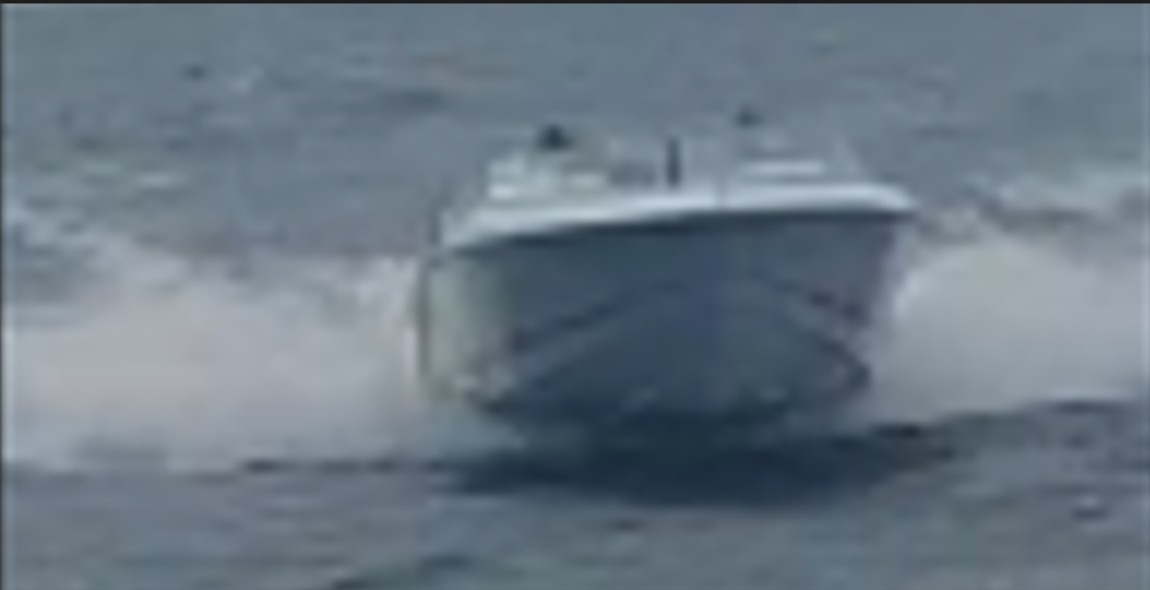
1.15 Mental models
People make decisions in part by building a mental representation of the way the world works; this representation is referred to as a mental model. The function of mental models is to order the knowledge of a person’s environment so that they can make useful inferences about what is happening, what will happen, and what can happen.D. Woods, S. Dekker, R. Cook, et al., Behind Human Error, 2nd Edition. (Ashgate Publishing, 2010), p. 104.
Mental models are critical for effective performance in dynamic, time-critical environments because they reduce the need for time-consuming evaluations of a given situation and enable quick actions. However, they can also lead to errors in how information is perceived.
In operational situations, people use their prior experience and knowledge to rapidly categorize a situation and select an appropriate course of action.G. Klein, “Naturalistic decision making,” Human Factors, Vol. 50, No. 3 (June 2008), pp. 456–460. In highly practised situations, attention and expectations are often driven by people’s existing mental models of situations, with previous experience dictating what information is important and providing an understanding of how those situations will likely unfold.
1.16 Previous occurrences
In addition to this occurrence, 235 occurrences were reported to the TSB between 2017 and 2023 where recreational craft and commercial vessels were involved in close-quarters situations with a risk of collision. In many of those occurrences, the commercial vessels involved took evasive action to prevent a collision. Fifteen of those occurrences involved collisions.Data on all marine transportation occurrences reported to the TSB is available at www.tsb.gc.ca/eng/stats/marine/data-6.html. It is updated monthly.
M23C0143 (Svanoy) – On 02 July 2023, the passenger ferry Svanoy, loaded with passengers and vehicles, departed the ferry dock at Saint-Joseph-de-la-Rive for its scheduled run to the dock at L’Isle-aux-Coudres, located on the St. Lawrence River. Visibility was restricted due to dense fog. When the Svanoy was 0.35 nautical miles south-southwest of the departing dock, the master spotted a pleasure craft ahead. Moments later, the Svanoy and the pleasure craft collided. Three of the pleasure craft’s occupants were thrown into the water, and the 4th occupant was trapped below deck. The 4 occupants were rescued by the ferry crew and were transported to a local hospital. Three of the occupants sustained minor injuries, and 1 sustained a serious injury. The pleasure craft sank, and the Svanoy sustained minor damage.
Following this investigation, the Board issued a safety concern about the adequacy of current requirements for training and certificating pleasure craft operators operating on high-traffic waterways.
M22P0298 (Saja Beija-Flor) – On 15 October 2022, the general cargo vessel Saga Beija-Flor and the pleasure craft BC4010135 came into close proximity and were at risk of collision in Vancouver Harbour, British Columbia. The pleasure craft was overturned, and its occupants entered the water. The occupants were subsequently recovered by vessels in the area and were transported to a local hospital.
Note that recreational boating occurrences are not reportable to the TSB, and the occurrences above are limited to pleasure craft that were involved in reportable occurrences with commercial vessels.
The TSB has investigated other passenger vessel occurrences that have had similar issues related to safe manning or emergency procedures and drills.
M22A0258 (Holiday Island) – On 22 July 2022, a fire broke out in the engine room of the passenger ferry Holiday Island. The passengers were evacuated, and the crew attempted to fight the fire but were overwhelmed and the vessel was eventually abandoned. The investigation identified safety deficiencies related to policies and procedures for emergency responses and communication on the part of the crew, the vessel operator, and first responders, as well as safety deficiencies related to accounting for passengers in case of an emergency. The investigation also identified safety deficiencies related to oversight by the authorized representative, leading the Board to issue a recommendation (M25-01).
M22C0231 (Sam McBride) – On 20 August 2022, the passenger ferry Sam McBride, with 6 crew members and approximately 910 passengers on board, struck the dock while berthing at the Jack Layton Ferry Terminal in Toronto, Ontario. Twenty passengers were reported injured. Emergency services responded to the occurrence, and 6 of the injured passengers were taken to hospital. The vessel and dock sustained damage. No pollution was reported.
M22A0332 (A.P.A. No. 18) – On 26 September 2022, shortly after a pilot was transferred to an inbound vessel, the deckhand on the pilot boat A.P.A. No. 18 fell overboard approximately 2 nautical miles east-southeast of the entrance to St. John’s Harbour, Newfoundland and Labrador. The master attempted to rescue the deckhand but was unable to do so alone. The deckhand was recovered by a vessel of opportunity after being in the water for approximately 20 minutes and was later pronounced dead.
1.17 Active recommendations
Following an occurrence on 22 August 2022, when the ferry Sam McBride struck the dock while berthing at its terminal, the Board issued a recommendation related to the evaluation of vessel evacuation procedures. For example, a realistic assessment of a vessel evacuation should include a number of people sufficient to simulate the conditions in an emergency. However, although there is a regulatory requirement that a passenger vessel will be evacuated within 30 minutes, TC has no formal procedure to assess if this requirement is being met. As a result, the Board recommended that
the Department of Transport implement a formal validation and approval process for passenger vessel evacuation procedures.
TSB Recommendation M24-02
2.0 Analysis
This analysis will focus on the factors leading to the collision, including the assessment of the passing situation, risk perception and decision making, and the pleasure craft’s unexpected alteration to port. This analysis will also examine recreational boating safety, including the requirements for obtaining a Pleasure Craft Operator Card (PCOC), as well as passenger safety on the Navark Faucon Millenium.
2.1 Assessment of the passing situation
In this occurrence, the Navark Faucon Millenium was travelling on a course of 245 °T at its usual operating speed of approximately 20 knots, while pleasure craft 59E53608 was heading 060°T at a speed of approximately 32 knots, giving a relative speed of approach of approximately 52 knots. By the time the Navark Faucon Millenium cleared l’Îlot de la Baronnie both the pleasure craft and the Navark Faucon Millenium were in view of each other, approaching on nearly reciprocal courses with a closest point of approach of approximately 7 m that would occur in less than a minute.
Most waterways in Canada do not have prescriptive speed restrictions and therefore operators are responsible for ensuring that vessels are operated at a safe speed. Determining a safe speed requires an understanding of the vessel’s manoeuvring characteristics and an assessment of the environment affecting the vessel.
The Collision Regulations require operators of power-driven vessels meeting on reciprocal or nearly reciprocal courses to alter their courses to starboard to ensure a safe passing distance, and requires them to reduce speed (or stop propulsion if necessary) to avoid a collision.
Before the collision, the master of the Navark Faucon Millenium observed that the pleasure craft would pass on his vessel’s port bow, given that the Navark Faucon Millenium and pleasure craft’s courses were nearly in a head-on situation. As a result, the master of the Navark Faucon Millenium maintained the vessel’s speed and slightly applied starboard helm. He expected that the pleasure craft operator would also take the necessary actions to ensure a safe passing distance.
In the minute before the collision, the pleasure craft operator assessed that his craft would approach the Navark Faucon Millenium at a close distance, but with enough margin for a safe passing. As a result, he maintained his craft’s course, heading, and speed.
Finding as to causes and contributing factors
The Navark Faucon Millenium and the pleasure craft approached each other on nearly reciprocal courses with a combined speed of 52 knots, and neither operator significantly altered course or reduced speed. Consequently, there was little margin of safety in the passing situation.
2.2 Pleasure craft dynamic instability
High-speed craft are subject to complex dynamic motions while planing, such as slamming, yawing, and broaching, that can lead to dynamic instability. This dynamic instability may be exacerbated by other forces, such as the current, wind, and waves.
In this occurrence, the pleasure craft operator likely underestimated the speed of his high-speed craft. The difference in the perceived speed of the pleasure craft and its actual speed was likely due to environmental conditions. The force and direction of the wind, mostly astern, coupled with the force and direction of the current, also astern, gave the impression of a lower speed and of almost no wind.
Because the pleasure craft operator had likely underestimated the speed of travel, he was not aware that the vessel was planing. Planing, combined with the high speed at which the pleasure craft was travelling, caused it to experience numerous uncontrolled dynamic motions, including yawing and broaching. These uncontrolled motions were observed in video recordings of the pleasure craft taken in the seconds before the collision.
Although the pleasure craft operator had practical on-water experience, he was likely unaware of the risks posed by dynamic instability and the need to reduce speed to maintain stability and control of his craft. Less than 4 seconds before the expected close port-to-port passing with the Navark Faucon Millenium, the pleasure craft suddenly veered 4° to port, which led to the collision.
When the pleasure craft suddenly veered to port approximately 110 m away from the Navark Faucon Millenium, there was no time for either the master of the Navark Faucon Millenium or the pleasure craft operator to take action to avoid the collision.
Finding as to causes and contributing factors
The pleasure craft veered suddenly toward the Navark Faucon Millenium 4 seconds before the anticipated passing, likely due to dynamic instability while planing at high speed. This, combined with the close passing distance, left insufficient time for either operator to respond to the unexpected change of course.
2.3 Risk perception and decision making
The master and pleasure craft operator perceived each other’s vessels less than a minute before the collision, and each made an assessment of the situation that informed their subsequent actions.
2.3.1 Master of the Navark Faucon Millenium
Having worked for Croisières Navark Inc. for 2 years, the master of the Navark Faucon Millenium had significant experience operating along the vessel’s routine passage. During that time, he encountered numerous close-quarters situations with pleasure craft; however, those craft tended to give way, and the master did not have to make any speed or course alterations. This repeated pattern eventually became integrated into the master’s mental model, which informs the expectations a person uses to understand how a situation is likely to play out and what their action should be in response to the cues they see.
In this occurrence, a pleasure craft approached the Navark Faucon Millenium at close quarters: a familiar situation. Although the master was aware that the pleasure craft and his own vessel were approaching each other on nearly reciprocal courses with a risk of collision, his perception of the risk was based on the expectation that the pleasure craft would eventually take the necessary action to ensure a safe passing. The master therefore maintained the Navark Faucon Millenium’s speed and slightly applied starboard helm, which had no significant effect on the passing distance between the Navark Faucon Millenium and the pleasure craft.
In situations such as this one, where there is uncertainty around the potential actions of the parties involved, people will tend to stick to their initial, strongly held mental model even in the face of conflicting information. The master’s expectation that the pleasure craft would ensure a safe passing influenced his decision not to take significant action to increase the distance between the 2 vessels, despite no change in the pleasure craft’s course and speed.
Finding as to cause and contributing factors
Relying on his previous experience, the master of the Navark Faucon Millenium expected the pleasure craft operator to take action to ensure a safe passing. This expectation resulted in him maintaining speed and only slightly altering course despite recognizing a risk of collision.
2.3.2 Pleasure craft operator
The pleasure craft operator had over 20 years of experience in recreational boating. He would have passed many other vessels throughout that time, which informed his approach to passing the Navark Faucon Millenium in this occurrence. It is likely that the pleasure craft operator’s perception of speed and control over the craft influenced his assessment of the anticipated passing.
Given the pleasure craft operator’s previous experience with successfully passing other vessels, he perceived that the risk for passing the Navark Faucon Millenium was acceptable. As a result, the pleasure craft operator did not take action to increase the distance between the 2 vessels by altering course to starboard to increase the passing distance and/or by reducing speed. In addition, there was no margin of error when the pleasure craft suddenly veered 4° to port.
Finding as to cause and contributing factors
The pleasure craft operator’s assessment of the passing was based on his previous experience and did not account for the effects of dynamic instability. As a result, he maintained his course and speed without realizing that there was little margin of safety to account for unexpected events that might cause his course to change.
2.4 Recreational boating safety
Recreational boating is a popular activity in Canada that involves some risk. From 2012 to 2021, there was an average of 106 recreational boating-related fatalities in Canada per year; 57% of those fatalities (60 deaths annually) involved powerboats.
2.4.1 Pleasure craft operator certification and training
Knowledge of the Collision Regulations and the effect of environmental conditions on vessel speed and manoeuvrability are fundamental to safe navigation and collision avoidance, particularly while navigating on shared public waterways with vessels of varying sizes and speeds.
All operators of a pleasure craft fitted with a motor (e.g., powerboats) on Canadian waters must carry proof of competency. Several documents are accepted as such, the most common being a PCOC. To obtain a PCOC, candidates must pass a theory test that may be taken online or in person. Most candidates take the test following a Transport Canada (TC)– accredited boating safety course, which is offered by an approved training provider, is optional for PCOC candidates, and must take no less than 3 hours.
The course must follow TC’s Boating Safety Course and Test Syllabus (TP 14932). The syllabus is broad and covers many safety-critical topics that should be covered in an accredited boating safety course. However, a boating safety course is optional for PCOC candidates, and as businesses that are in competition with each other, commercial course providers are incentivized to offer courses that do not take longer than the minimum 3 hours required by TC. Three hours of training does not allow course providers sufficient time to cover any topic in depth. The testing is the same for all pleasure craft operators regardless of where a pleasure craft is intended to be operated.
When the investigation reviewed a sample of PCOC course manuals that were available online, none provided guidance on boat manoeuvrability or the behaviour of high-speed craft . The hazard posed by larger commercial vessels was included, but guidance was limited to telling pleasure craft operators to be prepared to move and to be aware of the Collision Regulations, with no explanation of what manoeuvres are effective and what specific provisions of the Collision Regulations they need to be aware of. In this occurrence, the pleasure craft operator held a valid PCOC. Although he was operating in a shared waterway, his training and experience did not adequately prepare him to assess the risk of collision in such a complex environment.
The training and certification for pleasure craft operators is not specific to a type of pleasure craft, such as vessels with planing hulls. Therefore, the pleasure craft operator did not recognize that his vessel was susceptible to dynamic instability due to high speed. Because of his limited training on the Collision Regulations, the pleasure craft operator also likely did not have a full understanding of the need to take evasive action or to adjust the speed of his pleasure craft to increase the distance between the 2 vessels. Altogether, the circumstances of the collision indicate that the pleasure craft operator did not have sufficient knowledge to navigate safely in the prevailing conditions.
The result of this approach to certification is a population of pleasure craft operators that relies almost exclusively on personal limits and experience, with little contribution from training to standardize their assessment of risk and no requirement to demonstrate the application of their knowledge. Further, there is no requirement for refresher training to refamiliarize pleasure craft operators with the content of the boating safety course and test.
There is significant variability in pleasure craft operators’ perception of risk when operating a pleasure craft, especially in complex marine environments such as when sharing waterways with other traffic. There is also variability in how well pleasure craft operators manage those complex situations. This variability in risk perception means there is significant uncertainty regarding the ability of pleasure craft operators to be able to identify and manage the risks they may encounter.
One way to improve risk perception among pleasure craft operators is through training that is focused on developing cognitive skills such as hazard perception, situation awareness, and visual scanning, as opposed to focusing solely on the memorization of facts or rules. This approach tends to focus on scenario-based training or the use of simulations to expose trainees to real-world scenarios that, when accompanied with the appropriate feedback, helps to better calibrate a person’s mental model of the hazards associated with the task.
Finding as to risk
If pleasure craft operators rely primarily on their experience to assess the situations they encounter, they may not be able to manage risks in complex marine environments, such as shared waterways with other traffic.
2.4.2 Personal flotation devices
According to the Drowning Prevention Research Centre Canada’s 2026 report, the most common recreational boating accidents that led to death between 2012 and 2021 involved recreational boaters entering the water when a vessel capsized, followed by falling overboard or being thrown overboard. Wearing a personal flotation device (PFD) or lifejacket increases recreational boaters’ chances of survival if they enter the water by accident.
Although this information is widely available from TC and safety organizations that have a mandate to prevent drowning, not wearing a PFD or lifejacket remains the largest contributing factor leading to death among recreational boaters, accounting for 78% of all fatalities. TC requires that every vessel carry readily accessible PFDs or lifejackets that fit each occupant on board. In the fall of 2024, TC launched a public consultation regarding mandatory wearing of PFDs on open boats in Canada.
The pleasure craft involved in this occurrence carried a PFD for each occupant, and the occupants donned their PFDs after the occurrence. Although the wearing of a PFD was not a factor in this occurrence, there was a risk of the pleasure craft occupants entering the water as a result of the collision with the Navark Faucon Millenium by being ejected from the craft, or by the craft capsizing or sinking. Had any of the above occurred while the occupants were not wearing their PFDs, the occupants would have been at risk of drowning.
Finding as to risk
Pleasure craft occupants who do not wear a properly fitted PFD or lifejacket while they are on an open deck are at risk of drowning if they go overboard from the vessel.
2.5 Passenger safety
Passengers on ferries and river shuttles in Canada have an expectation of overall safety, because they are aware that commercial vessels are held to established safety standards and are inspected by regulatory and/or delegated surveyors, and that crews are trained in passenger management, handling emergencies, and safety maintenance. Several elements of the occurrence affected the safety of passengers on the Navark Faucon Millenium.
2.5.1 Risk assessment and hazard identification
In this occurrence, 9 passengers on board the Navark Faucon Millenium were injured when they were thrown to the deck following the collision. Their injuries were exacerbated by sharp edges at the base of the vessel’s bulwark stanchions, the exposed edge of the lifebuoy cradle, and unsecured objects on deck, specifically a stroller and the bicycle rack. The vessel had been inspected by TC, but these safety hazards, including the absence of anything to hold onto during an impact, were not specifically required to be addressed by regulation.
A safety management system is designed to recognize hazards that are unique to each vessel and operation. The physical hazards that were present on board the Navark Faucon Millenium are a good example of something that is not directly required to be addressed by a regulation but nonetheless presents a hazard. The risk assessment process that is part of a safety management system should identify all hazards that are present, not just those that are subject to regulations.
Finding as to causes and contributing factors
When passengers on board the Navark Faucon Millenium were thrown to the deck as a result of the collision, many of their injuries were exacerbated by physical hazards on board that had not been identified previously.
2.5.2 Safe manning
Before issuing a safe manning document (SMD), TC determines the minimum complement of the vessel that will ensure safe operations in both everyday and emergency situations.
TC’s assessment for the minimum safe manning level of the Navark Faucon Millenium was based on its sister vessel, the Navark XL5, which was also issued an SMD based on the precedents of similar vessels that engaged in similar voyages.
When a vessel has only 2 crew members on board, emergencies may occur that will result in only 1 crew member being available to conduct the emergency response because the other crew member must navigate the vessel. For example, in this occurrence, per the Navark Faucon Millenium’s emergency procedures, the master remained at the helm to navigate the vessel and to manage communications, and the deckhand was responsible for conducting the emergency response and ensuring the safety of the passengers. The number of injured passengers who required immediate medical attention made it impossible for the deckhand to provide first aid to all of them, let alone to simultaneously assist the other passengers and carry out his other emergency duties.
Although vessels may supplement the manning level that is set out in the SMD, there is no requirement for them to do so. As a result, the SMD plays a significant role in the safety of a vessel, its crew, and any passengers. As this and other TSB investigationsTSB marine transportation safety investigation reports M22A0332, M22C0231, M15A0009, M14C0156, and M11M0017. demonstrate, an insufficient number of crew members negatively impacts the effectiveness of an emergency response even when manning levels are in compliance with the SMD.
Finding as to risk
If the crew complement specified on a vessel’s SMD is insufficient to respond to an emergency, there is a risk that the emergency response will not ensure the safety of the vessel’s crew and passengers.
2.5.3 Emergency procedures and drills
On-board emergency procedures should reflect the characteristics of a vessel, ensure that its crew are able to perform the procedures as described, and detail the duties and responsibilities of personnel managing the emergency. For example, in the case of a collision, the master must verify the safety of the other vessels and render assistance to others involved in the occurrence if they can do so without compromising the safety of their vessel.
It is important for emergency procedures to be assessed on the basis of whether the people involved in an emergency can fulfill all of the requirements and duties expected of them. This means conducting routine realistic drills to assess the readiness of personnel and their ability to carry out the emergency procedures. Procedures that are not assessed and practised regularly may not be possible to follow when an actual emergency occurs.
Although the Navark Faucon Millenium crew practised some drills as required, they were single-scenario events. The drills were not created to deal with multiple scenarios such as a collision where someone went overboard and where there were injuries requiring first aid. Fire response was practised as a tabletop exercise, and the reality of fighting a fire on board while preparing the vessel for evacuation was not recognized. For example, according to the emergency procedures contained in the vessel’s evacuation plan, the deckhand is required to climb on top of the deckhouse to deploy 1 of the life rafts and bring it to the muster station while also managing passengers and assisting them in donning their lifejackets on the main deck.
The investigation found no evidence that TC had observed these drills and provided feedback to the crew. Practising realistic drills allows crew members to revise and refine emergency procedures, such as by increasing manning levels, changing the locations of emergency equipment, and changing roles and responsibilities.
Following the collision, and in accordance with the vessel’s emergency procedures, the master of the Navark Faucon Millenium proceeded immediately to Longueuil without checking on the status of the pleasure craft and its occupants or accounting for the passengers on his vessel. Because there was only 1 other crew member on board, the master knew there was a need for shore support to manage the emergency, and so his focus was on getting to shore as soon as possible.
The emergency procedures developed for the Navark Faucon Millenium directed the master to get to shore as soon as possible to get support, which undermined the obligation to remain on scene to render assistance to others involved in the emergency.
Finding as to risk
If on-board emergency procedures are incomplete and the practised drills do not reflect realistic emergencies, an actual emergency response may increase the risk to the vessel, crew, passengers, and others involved in the emergency.
3.0 Findings
3.1 Findings as to causes and contributing factors
These are the factors that were found to have caused or contributed to the occurrence.
- The Navark Faucon Millenium and the pleasure craft approached each other on nearly reciprocal courses with a combined speed of 52 knots, and neither operator significantly altered course or reduced speed. Consequently, there was little margin of safety in the passing situation.
- The pleasure craft veered suddenly toward the Navark Faucon Millenium 4 seconds before the anticipated passing, likely due to dynamic instability while planing at high speed. This, combined with the close passing distance, left insufficient time for either operator to respond to the unexpected change of course.
- Relying on his previous experience, the master of the Navark Faucon Millenium expected the pleasure craft operator to take action to ensure a safe passing. This expectation resulted in him maintaining speed and only slightly altering course despite recognizing a risk of a collision.
- The pleasure craft operator’s assessment of the passing was based on his previous experience and did not account for the effects of dynamic instability. As a result, he maintained his course and speed without realizing that there was little margin of safety to account for unexpected events that might cause his course to change.
- When passengers on board the Navark Faucon Millenium were thrown to the deck as a result of the collision, many of their injuries were exacerbated by physical hazards on board that had not been identified previously.
3.2 Findings as to risk
These are the factors in the occurrence that were found to pose a risk to the transportation system. These factors may or may not have been causal or contributing to the occurrence but could pose a risk in the future.
- If pleasure craft operators rely primarily on their experience to assess the situations they encounter, they may not be able to manage risks in complex marine environments, such as shared waterways with other traffic.
- Pleasure craft occupants who do not a wear a properly fitted personal flotation device or lifejacket while they are on an open deck are at risk of drowning if they go overboard from the vessel.
- If the crew complement specified on a vessel’s safe manning document is insufficient to respond to an emergency, there is a risk that the emergency response will not ensure the safety of the vessel’s crew and passengers.
- If on-board emergency procedures are incomplete and the practised drills do not reflect realistic emergencies, an actual emergency response may increase the risk to the vessel, crew, passengers, and others involved in the emergency.
4.0 Safety action
4.1 Safety action taken
4.1.1 TSB
Following this occurrence, the TSB issued a safety letterTSB Marine Transportation Safety Advisory Letter 01/24: Safety deficiencies on board the Navark Faucon Millenium (29 August 2024), at https://www.tsb.gc.ca/eng/securite-safety/marine/2024/m24c0142/m24c0142-0124.html (last accessed on 22 April 2026). to Croisières Navark Inc. on 29 August 2024 regarding the physical safety of the Navark Faucon Millenium. The letter noted the severity of passenger injuries following the collision, which were exacerbated by the lack of handholds, unsecured items on deck, and sharp edges on deck.
4.1.2 Transport Canada
On 29 June 2024, Transport Canada conducted an inspection of the hull, during which damage was found.
A periodic inspection on 22 October 2024 validated the temporary repairs to the hull, and a new deadline of 20 October 2026 was set for permanent repairs to be made.
4.1.3 Croisières Navark Inc.
Following the TSB’s safety letter, the company secured the bicycle rack to the deck of the Navark Faucon Millenium. Additional instructions about hanging on to the vessel while underway were added to the verbal passenger safety briefing at the beginning of each trip, and to the safety messages that play continuously on the television monitors on board each shuttle.
The Navark Faucon Millenium is testing protective strips on exposed sharp edges in order to determine the best course of action for applying them throughout the company’s fleet.
Handrails were added to the Navark Faucon Millenium during the 2024–2025 off-season.
Instructions for counting passengers, checking the condition of the other vessel, and providing assistance as needed were added to the safety management system procedures.
4.2 Safety action required
4.2.1 Training for pleasure craft operators
During the afternoon of 27 June 2024, the passenger vessel Navark Faucon Millenium departed Boucherville for the 30-minute passage to the Old Port of Montréal. There were 2 crew members and 38 passengers on board. Approximately 10 minutes later, pleasure craft 59E53608, with 6 people on board, collided with the Navark Faucon Millenium on the St. Lawrence River near Longueuil.
In this occurrence, the operator of the pleasure craft held a valid Pleasure Craft Operator Card (PCOC) and had over 20 years of experience in recreational boating. Although he was operating in a shared waterway, his training and experience did not adequately prepare him to assess the risk of collision in such a complex environment. As a result, he did not take action to increase the distance between the 2 vessels by altering course to starboard to increase the passing distance and/or by reducing speed, as required by the Collision Regulations.
Recreational boating is a popular activity in Canada that involves some risk. From 2012 to 2021, there was an average of 106 recreational boating–related fatalities in Canada. Of these fatalities, 57% (on average 60 deaths annually) involved powerboats.
To address the risks related to recreational boating, Transport Canada (TC) developed the Competency of Operators of Pleasure Craft Regulations. Under these regulations, anyone operating a pleasure craft that is fitted with a motor and is used for recreational purposes in Canadian waterways is required to carry proof of competency. Although a PCOC may be sufficient for operating in a simple environment such as a lake, this investigation and other investigations by the TSBTSB marine transportation safety investigation reports M23C0143 and M22P0298. have demonstrated that operators may not be prepared for situations such as those they may find themselves in when operating in a more complex environment.
In order to operate a pleasure craft safely, operators must have in-depth knowledge of the Collision Regulations and be aware of the need to take evasive action or adjust the speed of their craft to increase the distance between 2 vessels that are passing each other. Operators must also be aware of the effects of environmental conditions on the speed and manoeuvrability of their vessel, which is essential to collision prevention. This knowledge is especially important when pleasure craft are being operated on waterways in proximity to vessels of different sizes, such as shuttles, and in confined areas.
According to TC, the most common way for pleasure craft operators to prove their competency is to obtain a PCOC. To do this, candidates must pass a theory test. Taking a TC-accredited boating safety course is optional but recommended, and such a course must take no less than 3 hours. However, because boating safety training providers are private entities and in competition with each other, there is no incentive for them to give a longer training course. Three hours of training does not allow training providers to cover each topic in depth. The limited duration of the training results in pleasure craft operators relying primarily on their personal limits and their experience, and the training does not greatly help them understand the risks of navigating in proximity to other vessels.
The training syllabus for obtaining a PCOC is broad and covers many safety-critical topics. The TSB investigation reviewed a sample of PCOC manuals that were available online and found that none of the manuals provided guidance on boat manoeuvrability nor on the behaviour of high-speed craft. The hazard poses by larger commercial vessels was included, but guidance was limited to telling pleasure craft operators to be ready to move and to be aware of the Collision Regulations, and there was no explanation of what manoeuvres are effective and the specific provisions of the Collision Regulations to be aware of.
The PCOC does not restrict operators to specific waters, nor does it limit operators to a specific size or type of pleasure craft. Whether operating a small open boat with an electric motor on a small lake or a powerboat on a high-traffic waterway, the certification requirements are the same.
Other than the proof of competency, no mandatory knowledge or practical training is required to operate a pleasure craft in Canada. In addition, the PCOC does not expire, and no refresher training is required. Such training would give pleasure craft operators the opportunity to refresh their memory of the course contents and possibly refamiliarize them with the navigation rules. Without this training, operators may not be prepared to respond predictably to risks of collision.
Training for pleasure craft operators has been identified as a safety deficiency in previous TSB investigations. In 2022, the TSB carried out a survey of Canadian licensed marine pilots in support of an investigation between a large commercial vessel and a pleasure craft. Seventy-nine percent (79%) of respondents indicated that they had occasionally or with some regularity experienced close-quarters situations with pleasure craft. The survey indicated that better education and training for pleasure craft operators was the most important factor to help reduce close-quarters situations and risk of collision with commercial vessels.
Following a collision between the passenger ferry Svanoy and a pleasure craft in 2023, the Board issued the following safety concern about the adequacy of the PCOC program:
[T]he Board is concerned that the current requirements for training and certificating pleasure craft operators do not provide them with the depth of knowledge necessary for safe navigation on high-traffic waterways.
This gap in training and certification means that pleasure craft operators rely more on their personal limits and experience, and the training provides little or no information to help operators more accurately evaluate the risk of various situations on the water. As a result, pleasure craft operators vary widely in their ability to identify hazards and manage the associated risks during marine operations, namely in more complex situations such as navigation in waters with commercial traffic, and they vary widely in their ability to manage these complex situations.
If pleasure craft operators rely primarily on their experience to assess the situations they encounter, they may not be able to manage risks in complex marine environments, such as shared waterways with other traffic.
To learn a complex skill such as vessel navigation, a structured approach to training is needed. There are different ways to achieve the desired goal, but there are some recognized approaches that have become widespread as a result of their success, such as graduated licensing and periodic refresher training.
For this reason, the Board recommends that
the Department of Transport modify the Pleasure Craft Operator Competency Program to ensure that pleasure craft operators acquire and maintain a sufficient level of knowledge to be able to respond to the unique elements of the conditions in which they operate.
TSB Recommendation M26-01
This report concludes the Transportation Safety Board of Canada’s investigation into this occurrence. The Board authorized the release of this report on 15 April 2026. It was officially released on 21 May 2026.
Appendices
Appendix A - Diagram of the Navark Faucon Millenium’s layout and location of life-saving equipment
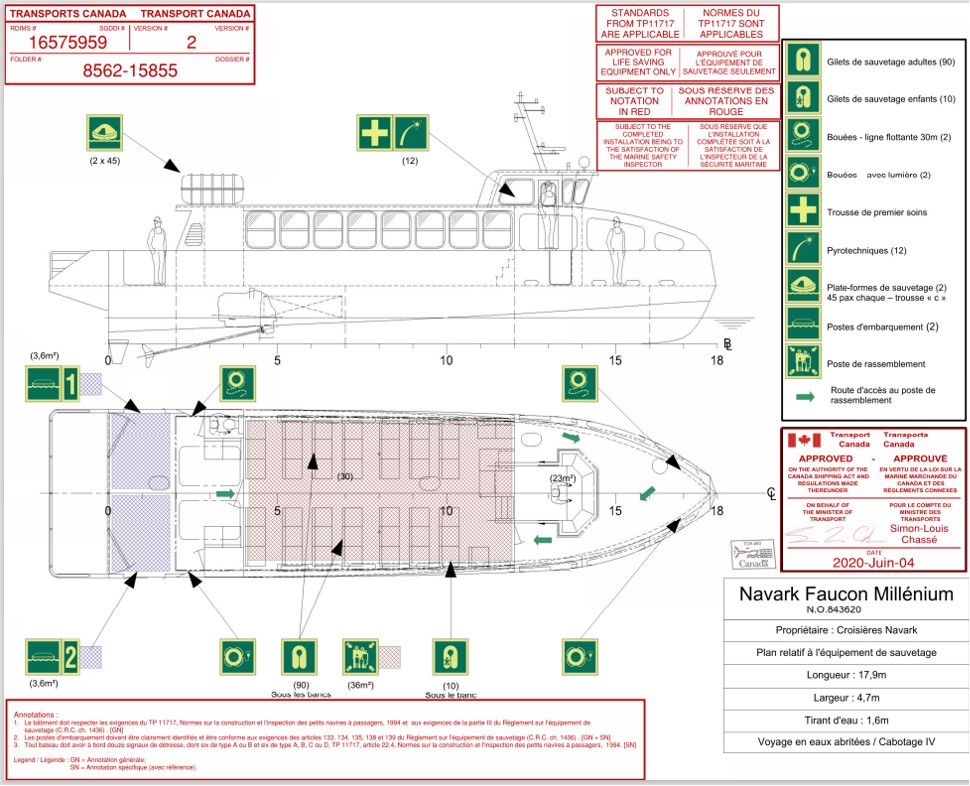
Source: Transport Canada